Fume hood exhaust air setpoint, linear sash position and face velocity sensor (FhSpEh15)
Overview
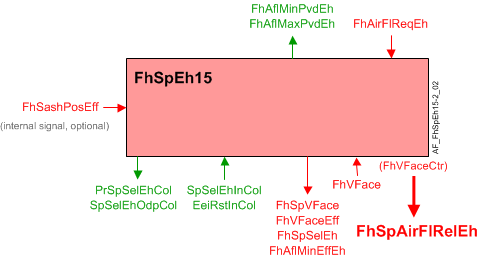
The application function "Fume hood exhaust setpoint 15, face velocity and linear sash position" (FhSpEh15) is used to determine the exhaust volume setpoint based on a combination of a linear relationship with the fume hood sash position and face velocity sensor. Each one is used to separately calculate a value for the exhaust flow setpoint. The larger value is the effective exhaust flow setpoint.
This AF does not have any outputs associated with physical devices.The primary analog outputs of this AF are the calculated value objects:
- Exhaust volume setpoint (FhSpAirFlEh), also present on chart output pin
- Relative exhaust volume setpoint (FhSpAirFlRelEh), also present on chart output pin
- Face velocity setpoint (FhSpVFace)
- Calculated effective face velocity (FhVFaceEff)
Main features:
- Exhaust volume setpoint
- Calculated face velocity
Function
| Command or request (or related) |
| Notification of condition or status, or availability |
| Device mode |
| Interlock (internal signal, not a BACnet object; see Interlocks section for additional information) |


Exhaust setpoint selection: The exhaust setpoint selection (FhSpSelEh) is a configurable multistate process value:
- Off
- Auto
- Setpoint 1
- Setpoint 2
- Setpoint 3
FhSpSelEh can be adjusted from the ODP when the setpoint adjustment features on the ODP are activated.
The application monitors the multistate calculated value object, exhaust air setpoint selection input value (FhSpSelEh), that is connected to the ODP. The application will write the current state of the exhaust setpoint selection on two multistate process value objects, exhaust air setpoint selection to ODP (SpSelEhOdpCol) and present exhaust air setpoint selection (PrSpSelEhCol).
A configuration extension parameter determines the value for the manual setpoints; SpOff, setpoint 1, setpoint 2, and setpoint 3. Other parameters configure the units for each of the manual setpoints.
Unit options | Enumeration value |
|---|---|
m/s | 74 |
ft/min | 77 |
% | 98 |
ft3/min | 84 |
l/s | 87 |
m3/h | 135 |
- If a velocity setpoint is selected (m/s or ft/min), the manual setpoint will be used to calculate the exhaust airflow setpoint based on the sash face area.
- If % is selected, the resulting manual setpoint will be a percentage of the current auto setpoint.
- If an airflow setpoint is selected (ft3/min, l/s, or m3/h), the resulting manual setpoint will be set equal to the value.
Setpoint 1, Setpoint 2, and Setpoint 3 will be limited by the minimum exhaust airflow setpoint, the Off setpoint will be allowed to be set to 0.
A manual setpoint of Off, Setpoint 1, Setpoint 2, or Setpoint 3 received from the ODP updates the value of the FhSpSelEh and sets the priority to 13. A setpoint of Auto received from the ODP will relinquish priority 13 for FhSpSelEh and update the value to priority 15.
The manual setpoint is set to Auto based on a change of FhOpMod and RlqManSpSelEh. The manual setpoint can be released when FhOpMod changes to Off or to Low air volume flow. The manual setpoint will not be released if the setpoint is configured to trigger emergency purge.
ManOpLockCnf defines when the ODP will be locked based on FhOpMod. The user setpoint selection will be locked by setting the priority of Fume hood exhaust setpoint selection (FhSpSelEh) to 12. The priority is passed down to SpSelEhOdp and PrSpSelEh.
FhSpSelEh Present priority | Exhaust setpoint selection to ODP | Present exhaust air setpoint selection |
|---|---|---|
<13 | 12 | 12 |
13 | 13 | 13 |
>13 | 15 | 15 |
SpSelEhLoAirFl defines how FhSpSelEh will be set when the FhOpMod changes to low air volume flow.
- When the configuration extension item is set to disabled, no action is taken.
- If the configuration extension item is set to off, setpoint 1, setpoint 2, or setpoint 3, the exhaust setpoint selection will be set to that value.
- The FhSpSelEh will return to Auto when the FhOpMod changes to Control.
Emergency purge: If the configuration extension item is set to off, setpoint 1, setpoint 2, or setpoint 3 and the exhaust setpoint selection is set to that value, SpEmgPrg is turned on.
Note:
The QMX3.P88 fume hood operating display does not have a specific button for emergency purge. The configuration extension item EmgPrgCnf allows one of the manual setpoints to be used to activate emergency purge.
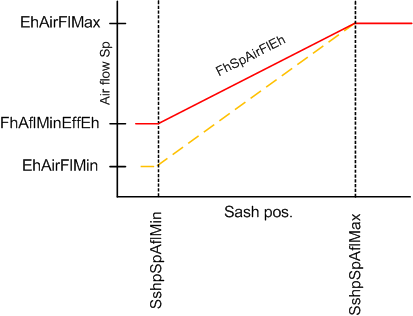
Exhaust airflow effective minimum: The exhaust airflow effective minimum can be affected by the FhOpMod and the exhaust airflow request from the room.
When there is no request from the room and the FhOpMod is control, the exhaust airflow effective minimum will be set equal to the EhAirFlMin.
When there is no request from the room, the FhOpMod is low air volume flow and the FhUcdAflEhMin is not equal to zero, the FhAflMinEffEh will be set equal to FhUcdAflEhMin.
If there is no request from the room, the FhOpMod is low air volume flow and FhUcdAflEhMin is equal to zero, the FhAflMinEffEh will be set equal to EhAirFlMin.
Face velocity setpoint: When a manual setpoint (Sp1, Sp2 or Sp3) is active through the exhaust air setpoint selection and configured for velocity (m/s or ft/min), then the FhSpVFace will be set equal to the value of that manual setpoint.
When a manual setpoint is not active and the FhOpMod is set to Low airflow for a time longer than switch delay to unoccupied setpoint (DlyOnSpUcd ), the FhSpVFace is set equal to the FhUcdSpVFace, otherwise it is set equal to FhOcdSpVFace.
When the fume hood operating mode (FhOpMod) is set to fire, the face velocity setpoint will be set at priority 2 based on the SpEhFire.
When the FhOpMod is set to emergency or open, the face velocity setpoint will be set at priority 2 based on the SpEmgPrg.
Exhaust airflow setpoint: A velocity sensor and a linaer relationship between the sash position and the effective minimum and maximum exhaust airflow setpoints are used to separately calculate a value for the exhaust flow setpoint.
When the fume hood operating mode is set to Control, the exhaust setpoint selection is Auto, and the balancing state is not balancing, the exhaust airflow setpoint (FhSpAirFlEh) will be set equal to the larger of the linear setpoint and setpoint calculated from the face velocity sensor.
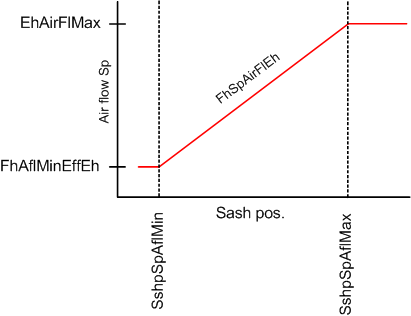
The priority for the exhaust airflow setpoint is set based on the priority of the fume hood operating mode object.
Fume hood operating mode present priority | Exhaust volume setpoint priority |
|---|---|
1-3 | 2 |
4-6 | 5 |
7-15 | 15 |
Face velocity control: The application reads a sensor called a “face velocity sensor” or “through-the-wall sensor” to measure an air velocity that represents the face velocity (FhVFace). The velocity averaged over the open face area of the hood may differ significantly from the velocity measured through the sensor. The application includes a configurable conversion to calculate a representative face velocity from the sensed velocity, a configurable filter constant and a correction factor are involved to convert the raw measured face velocity to the effective face velocity (FhVFaceEff). The effective face velocity is set to valid only when FhVFaceis valid.
This application applies a cascade feedback loop to drive the calculated face velocity to the face velocity setpoint. The face velocity loop is the outer loop, calculating the setpoint of the exhaust flow inner loop. The outer loop outputs 0-100% representing exhaust airflow setpoint from minimum to maximum, and then converts the percentage value to airflow volumetric value, this value is further compared with the linear exhaust flow setpoint calculated from sash position to choose whichever is greater for exhaust damper modulating (inner loop of cascade control).
The loop must not be allowed to wind up when the exhaust volume setpoint is not being controlled by the loop.
Emergency alarm exhaust volume setpoint: The emergency purge exhaust setpoint (SpEmgPrg) is a configuration extension, entered as a percentage of setpoint. (see Configuration)
Fire: The fire exhaust setpoint (SpEhFire) is a configuration extension, entered as a percentage of setpoint. (see Configuration)
Stabilizing jet feature: The stabilizing jet failure setpoint is a configuration extension item that is entered in airflow units. When the stabilizing jet failure input indicates there is a problem with the stabilizing jet fan then the setpoint determined by the sash position will be increased by the amount in the configuration extension item. The stabilizing jet alarm does not affect the face velocity setpoint.
Decommission exhaust volume setpoint: When the fume hood operating mode is set to Off then FhSpAirFlEh will be set to 0.
Balancing mode exhaust volume setpoint: If the balancing command (VavEhBalCmd) is set to Balancing, the exhaust airflow setpoint (FhSpAirFlEh) is determined by the Balancing Mode (VavEhBalMod).
Relative setpoint: The relative airflow setpoint for the fume hood is a calculated analog value that is normalized as a percentage of the exhaust airflow setpoint based on the nominal (rated) value for the fume hood airflow, where 100% equals nominal and the relative value will not be limited to 100%.
Energy efficiency indication: If a manual setpoint is selected that results in a higher exhaust airflow setpoint than the auto setpoint, the setpoint AF notifies the ODP to set the energy efficiency indicator (green leaf) (EeiRstInCol) to Poor (2).
If the balancing command (VavEhBalCmd) is Balancing or the fume hood operating mode (FhOpMod) is Fire, Emergency purge, or Open, the energy efficiency indicator (green leaf) is set to Undefined (1).
If none of the above conditions exist, the energy efficiency indicator (green leaf) will be set to Good (4).
If the energy efficiency indicator reset button (REeiRstIn) is pressed when the high manual setpoint indicator is on, the manual setpoint will be released and the auto setpoint will be used.
Configuration
 Objects
Description | Object | Type | Default value |
|---|---|---|---|
Fume hood unoccupied face velocity setpoint | FhUcdSpVFace | ACnfVal | 0.41 [m/s] |
Fume hood occupied face velocity setpoint | FhOcdSpVFace | ACnfVal | 0.41 [m/s] |
Fume hood unoccupied minimum exhaust air volume flow | FhUcdAflEhMin | ACnfVal | 0 [m3/h] |
Fume hood exhaust manual air volume flow setpoint | FhSpAirFlManEh | ACnfVal | 5 [m3/h] |
 Parameters
Description | Parameter | Default value |
|---|---|---|
Sash position for maximum exhaust air volume setpoint | SshpSpAflMax | 48.0 [cm] |
Sash position for minimum exhaust air volume setpoint | SshpSpAflMin | 2.0 [cm] |
Maximum exhaust air volume setpoint based on sash position | SpAirFlMaxSshp | 100 [m3/h] |
Minimum exhaust air volume setpoint based on sash position | SpAirFlMinSshp | 50 [m3/h] |
Emergency purge setpoint 1:Disabled | SpEmgPrg | 150 [%] |
Fire exhaust setpoint | SpEhFire | 50 [%] |
Added air volume flow during stabilizing jet failure | AddAflStbFail | 200 [m3/h] |
Time for increasing exhaust air volume flow setpoint | TiIcrSpAirFlEh | 0 [s] |
Time for decreasing exhaust air volume flow setpoint | TiDcrSpAirFlEh | 0 [s] |
Attenuation filter face velocity | AtnFltVFace | 2 [s] |
Switch-on delay to unoccupied setpoint | DlyOnSpUcd | 30 [s] |
Minimum air volume flow setpoint by room request | SpAirFlMinReq | 0 [m3/h] |
Unit for setpoint off 1:m/s | SpOffUnit | 5:% |
Setpoint off | SpOff | 100 |
Unit for setpoint 1 Enumeration see SpOffUnit | Sp1Unit | 5:% |
Setpoint 1 | Sp1 | 100 |
Unit for setpoint 2 Enumeration see SpOffUnit | Sp2Unit | 5:% |
Setpoint 2 | Sp2 | 100 |
Unit for setpoint 3 Enumeration see SpOffUnit | Sp3Unit | 5:% |
Setpoint 3 | Sp3 | 100 |
Emergency purge configuration 1:Disabled | EmgPrgCnf | 1:Disabled |
Exhaust setpoint selection on low air volume flow Enumeration see EmgPrgCnf | SpSelEhLoAirFl | 1:Disabled |
Relinquish manual mode on exhaust setpoint selection 1:None | RlqManSpSelEh | 2:Off |
Manual operation lock configuration Enumeration see RlqManSpSelEh | ManOpLockCnf | 2:Off |
Retain manual setpoint after power failure 0:No | ManSpAfPwrFail | 0:No |
Length unit | LngtUnit | [cm] |
Air volume flow unit | AirFlUnit | [m3/h] |
Interface
Interface | Description | Type | Ref. | Owned by | |
|---|---|---|---|---|---|
FhVFace | Fume hood face velocity | AI | ◉ | Room segment / Field device | |
FhSpAirFlEh | Fume hood exhaust air volume flow setpoint | APrcVal | ● | - | |
FhSpAirFlRelEh | Fume hood exhaust setpoint for relative air volume flow | ACalcVal | ● | - | |
FhSpVFace | Fume hood face velocity setpoint | APrcVal | ● | - | |
FhSpSelEh | Fume hood exhaust air setpoint selection 1:Off | MPrcVal | ● | - | |
FhVFaceEff | Fume hood effective face velocity | ACalcVal | ● | - | |
FhAirFlReqEh | Fume hood exhaust air volume flow request from room | ACalcVal | ● | - | |
FhAflMinEffEh | Fume hood exhaust effective minimum air volume flow | ACalcVal | ● | - | |
FhAflMaxPvdEh | Fume hood maximum provided air volume flow for exhaust | ACalcVal | ● | - | |
FhAflMinPvdEh | Fume hood minimum provided air volume flow for exhaust | ACalcVal | ● | - | |
FhVFaceCtr | Fume hood face velocity controller | Controller | ● | - | |
EeiRstInCol | Collection of reset energy efficiency indicator input value | ColView | ● | - | |
| EeiRstInRs | Result of reset energy efficiency indicator input value 0:Off | BCalcVal | ● | - |
EeiRstIn | Reset energy efficiency indicator input value 0:Off | BCalcVal | ◉ | Room segment / Field device | |
SpSelEhInCol | Collection of exhaust air setpoint selection input value | ColView | ● | - | |
| SpSelEhInRs | Result of exhaust air setpoint selection input value Enumeration see FhSpSelEh | MCalcVal | ● | - |
SpSelEhIn | Exhaust air setpoint selection input value Enumeration see FhSpSelEh | MI | ◉ | Room segment / Field device | |
SpSelEhOdpCol | Collection of exhaust air setpoint selection to ODP | ColView | ● | - | |
| SpSelEhOdp | Exhaust air setpoint selection to ODP Enumeration see FhSpSelEh | MO | ◉ | Room segment / Field device |
PrSpSelEhCol | Collection of present exhaust air setpoint selection | ColView | ● | - | |
| PrSpSelEh | Present exhaust air setpoint selection Enumeration see FhSpSelEh | MPrcVal | ◉ | Room segment / Field device |
FhEei | Fume hood energy efficiency indication 1:Undefined | MCalcVal | ◉ | Hvac16 | |
FhUcdSpVFace | Fume hood unoccupied face velocity setpoint | ACnfVal | ● | - | |
FhOcdSpVFace | Fume hood occupied face velocity setpoint | ACnfVal | ● | - | |
FhUcdAflEhMin | Fume hood unoccupied minimum exhaust air volume flow | ACnfVal | ● | - | |
FhSpAirFlManEh | Fume hood exhaust manual air volume flow setpoint | ACnfVal | ● | - | |
Engineering and commissioning
Optional.