Extract air VAV box, pressure dependent control (VavEx15)
| This application function operates the modulation of a damper. The resulting change of the air volume flow is pressure dependent. The air volume flow setpoint is calculated based on request for extract flow, relative to the volume of air flowing through the supply terminal following the principle of «extract tracks supply». In this AF, duct area is for user reference only; it is not used for damper position calculation. There is no coefficient object or coefficient calculation logic. Air balancing functions are provided by manually changing min and max damper position setpoints. |
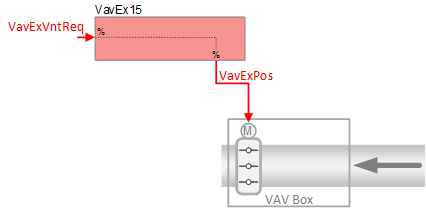
Required elements and how to configure them:
Element | I/O | Signal type |
|---|---|---|
VavExPos "Extract air VAV position" | On-board output, Extract air VAV position | 0…10V or 3-position |
or KNX PL-Link device, Extract air VAV | Position control |
Function
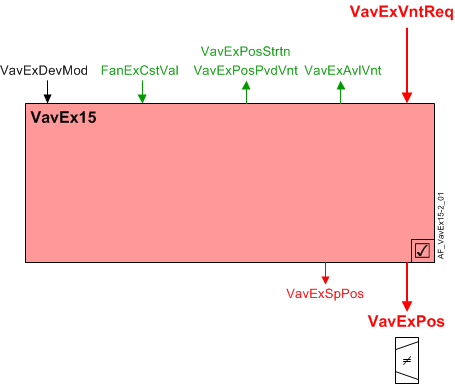
The figure below shows BACnet objects associated with this application function. Primary signal flow is summarized as follows:
VAV extract ventilation request (VavExVntReq) is received and processed into the output signal (in percent) for VAV extract damper position (VavExPos).
Basic function: Accept request signal from associated room controller and map it to damper position setpoint; Pass result through a device mode logic switch prior to outputting as a command to the object that controls the extract damper position.
| Command or request (or related) |
| Notification of condition or status, or availability |
| Device mode |


Saturation signal: The saturation signal (VavExPosStrtn) is a binary object that is True ("Starved") when the VAV extract air terminal cannot get enough air for a time exceeding a built-in time delay.
Note
VavExPosStrtn is always off if parameter EnStrtnCal = 0 (No). This allows the user to exclude a particular terminal from the saturation pressure reset system.
Available status: When the VAV extract damper is available for extract air ventilation, the binary output signal that indicates availability (VavExVntReq) will be "Yes" (available).
For available status to be "Yes", device mode must equal "Control mode" (modulation).
Device mode: The input signal for device mode is a multistate value.
VavExDevMod supports the following states:
- Off
- Control mode (modulation)
- Max.air vol.flow
- Min.air vol.flow
- Smoke ctrl.air flow setp (manually entered damper setpoint value for smoke control)
Fan coasting feature: The fan coasting feature prevents premature closing of the extract damper while the AHU fan is coasting down. This might occur during a switch between operating modes (for example, switching from Comfort to Economy).
The fan coasting feature is active when:
- The extract air damper is the only extract damper that is open – all other extract air dampers are closed.
- The AHU fan has been turned off and is coasting down.
- The damper position setpoint signal (VavExSpPos) while on its way to zero, falls below the air flow demand hysteresis setting (HysPosDmd).
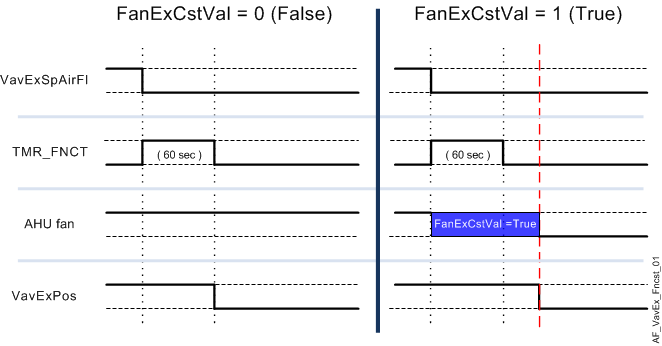
When these conditions are true, the boolean extract fan coasting signal (FanExCstVal) will equal 1 (True) and the damper is reset to its last (previous) operating position / value. This keeps the damper open while the fan coasts down to prevent extract duct over-pressure.
In addition to the fan coasting signal freezing the damper in place, an internal timer function was activated when (VavExSpAirFl) initially dropped below (HysPosDmd). The fan coasting signal and the timer (60 seconds) must both finish (return to False) before the extract damper can close. See the figure below.
Note
The internal timer operates independently and regardless of VavExSpPos. Once the timer is activated, the extract damper is frozen in place until the counter reaches zero, after which the damper may close.
Configuration
 Objects
Description | Object | Type | Default value |
|---|---|---|---|
Air flow settings | |||
Extract air VAV smoke control setpoint position | VavExSpPosSmk | ACnfVal | 50 [%] |
Extract air VAV maximum position for ventilation | VavExPosMaxVnt | ACnfVal | 100 [%] |
Extract air VAV mininimum position for ventilation | VavExPosMinVnt | ACnfVal | 0 [%] |
Duct | |||
Extract air VAV duct area | VavExDuctArea | ACnfVal | 0.05 [m2] |
Extract air VAV duct shape | VavExDuctShape | MCnfVal | 2:Round |
Extract air VAV dimension A | VavExDmsnA | ACnfVal | 20 [cm] |
Extract air VAV dimension B | VavExDmsnB | ACnfVal | 20 [cm] |
 Parameters
Description | Parameter | Default value |
|---|---|---|
Saturation calculation | ||
Enable saturation calculation Saturation signal calculation logic: 0:No | EnStrtnCal | 1:Yes |
Saturation level | StrtnLvl | 90 [%] |
Switch-on delay saturation | DlyOnStrtn | 60 [s] |
Position demand | ||
Switch-on point for position demand | SwiOnPtPosDmd | 4 [%] |
Hysteresis for position demand | HysPosDmd | 2 [%] |
Rate limitation for position | RateLmPos | 60 [s] |
Interface
Interface | Description | Type | Ref. | Owned by |
|---|---|---|---|---|
VavExPos | Extract air VAV position | AO | ◉ | Room segment / Device |
VavExSpPos | Extract air VAV setpoint position | APrcVal | ● | - |
VavExPosStrtn | Extract air VAV position saturation 0:Satisfied | BCalcVal | ● | - |
VavExDevMod | Extract air VAV device mode 1:Off | MPrcVal | ● | - |
VavExVntReq | Extract air VAV ventilation request | ACalcVal | ● | - |
VavExAvlVnt | Extract air VAV available for ventilation 0:No | BCalcVal | ● | - |
FanExCstVal | Coasting value of extract air fan 0:Off | BCalcVal | ● | - |
VavExSplyAir | Extract air VAV supply chain for air | GrpMbr | ● | - |
VavExBalSta | Extract air VAV balancing state 1:Initial | MCnfVal | ● | - |
VavExDuctArea | Extract air VAV duct area | ACnfVal | ● | - |
VavExDuctShape | Extract air VAV duct shape 1:Rectangular | MCnfVal | ● | - |
VavExDmsnA | Extract air VAV dimension A | ACnfVal | ● | - |
VavExDmsnB | Extract air VAV dimension B | ACnfVal | ● | - |
VavExSpPosSmk | Extract air VAV smoke control setpoint position | ACnfVal | ● | - |
VavExPosMaxVnt | Extract air VAV maximum position for ventilation | ACnfVal | ● | - |
VavExPosMinVnt | Extract air VAV mininimum position for ventilation | ACnfVal | ● | - |
Engineering and commissioning
Check for correct damper actuator installation. Actuator mis-wiring or improper installation is a major cause of common problems.