Physical network topology
Physical network topology refers to how devices are physically connected on the network using cabling. BACnet/SC uses the same physical layer as BACnet/IP – Ethernet cabling. The difference is only in the logical operation - how devices behave on the network based on BACnet/SC functions in their firmware. The same physical topologies used for BACnet/IP can also be used for BACnet/SC networks. The cabling of the underlying IP network can be configured freely. It can be a star, a bus, a daisy chain or any other Ethernet topology.
BACnet/SC is an IT friendly protocol which is well-suited for use in IT environments. IT professionals strongly prefer star topology Ethernet connections (home runs from the device to the switch) because there is a much lower risk of failure, no chance of network loops, and single devices can be blocked on the network using IT management techniques. Building automation professionals may prefer a daisy chain or redundancy ring Ethernet topology because it is cost-effective and self-contained. It is very important for IT and OT professionals to collaborate early in the project and decide upon the physical topology to be used.
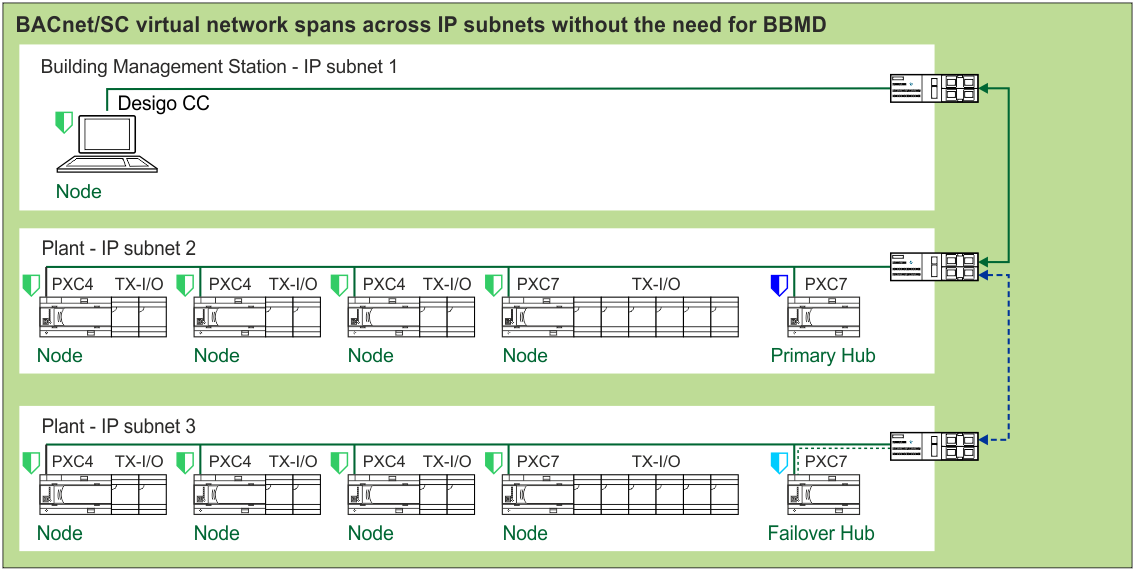
The daisy-chaining of BACnet/SC devices is only allowed for node devices. Hub devices must never be daisy chained. No more than 20 BACnet/SC node devices should be daisy-chained together on the same segment to maintain performance.
There is a lot of installed BACnet/IP equipment used in commercial building automation projects. Mixed BACnet networks (using a mix of BACnet/IP and BACnet/SC data links) need to be treated just like an unsecured BACnet/IP network. Only the segments utilizing the BACnet/SC virtual link layer have secured communication and authentication of hub and node devices.

A daisy chain topology for the PXC7 primary hub and failover hub devices is not recommended. The BACnet/SC hub devices must be always reachable on the network, or BACnet/SC communication will fail! Star topology (home run) connection to Ethernet switches or IP routers is strongly recommended. BACnet/SC node devices may be daisy-chained in accordance with the following device limits guidelines.
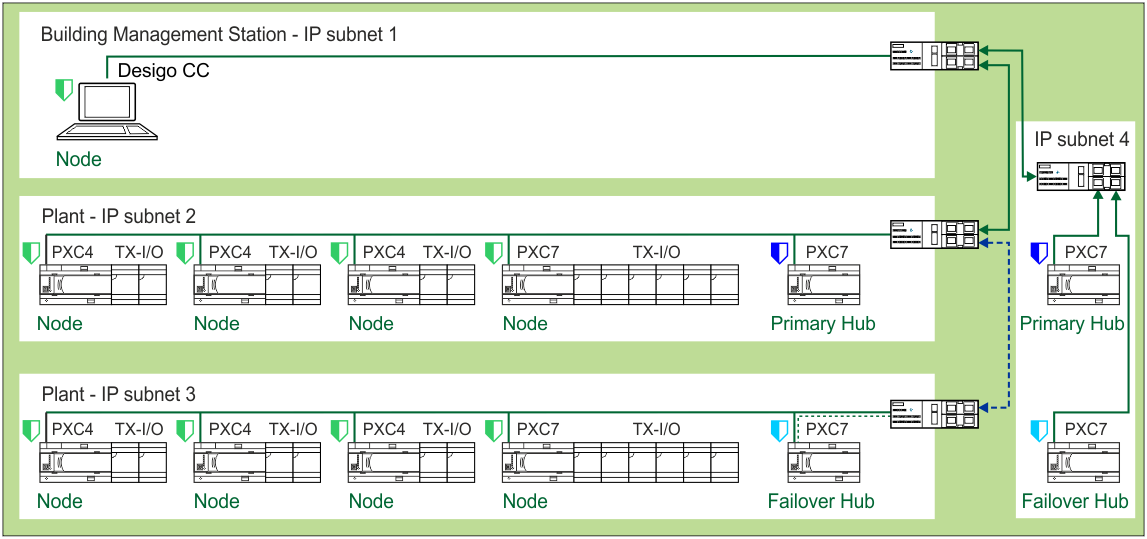
Alternatively, a hub device can be the very first device in a daisy chain topology with its own home run connection to an Ethernet switch or IP router.