Defining the aggregation of the demand signal
The heating and cooling demand signals can be configured individually for each zone. This means that the optimum setting can be defined for each zone according to the room specification or behavior.

A manager device and the subordinate devices can be in different zones. In this case, several demand signals are created in the control program, one for each zone.
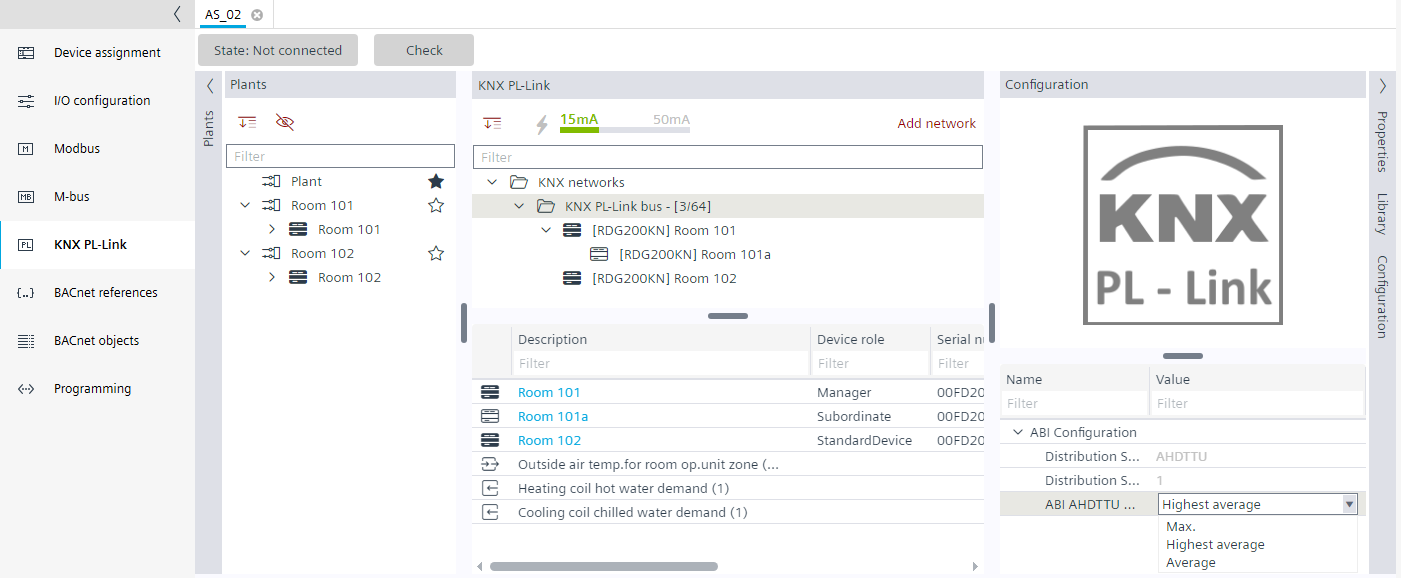
- In the KNX PL-Link area, select the KNX PL-Link bus.
- Select the data point Heating coil hot water demand (1).
- Select the Configuration tab on the right.
- In the Aggregation Function drop-down list, select an option:
- Maximum
- Highest average
- Average - Adapt the other demand signals as needed.
Explanation of the aggregation function
Maximum
- the highest demand value is taken to determine the new value
- this method ensures full comfort level since the room with the highest energy demand controls the flow temperature
Highest average
- only the 10 highest, valid demand values in the range 10%...100% are taken to calculate the new value, for example, (90%+98%+33%+56%) / 4 = 69.25%
- demand values <10% are ignored
- the number of 10 considered entries as well as the threshold values 10% / 100% are fixed
- the highest average method is a good compromise between energy efficiency and comfort since only the rooms with relevant energy demand are considered, but the rooms with highest demand may not reach the comfort setpoint
- the highest average method does not make a lot of sense if fewer than 10 hot / cold water consumers are connected to the distribution segment
Average
- all valid demand values in the range 0%...100% are taken to calculate new value
- the average method ensures the highest energy efficiency since rooms with low energy demand will lower the averaged resulting demand
- some rooms may not reach the comfort setpoint, especially in case of bad hydronic balancing