Scenario 0: Two BACnet networks on different Ethernet ports
Separate BACnet/SC and BACnet/IP traffic
BACnet networks are logically routed and physically separated but require BACnet routing to communicate between the Ethernet ports: You can operate BACnet/IP on WANs and LANs, but /SC must operate on a LAN, separating secure from unsecure BACnet traffic.
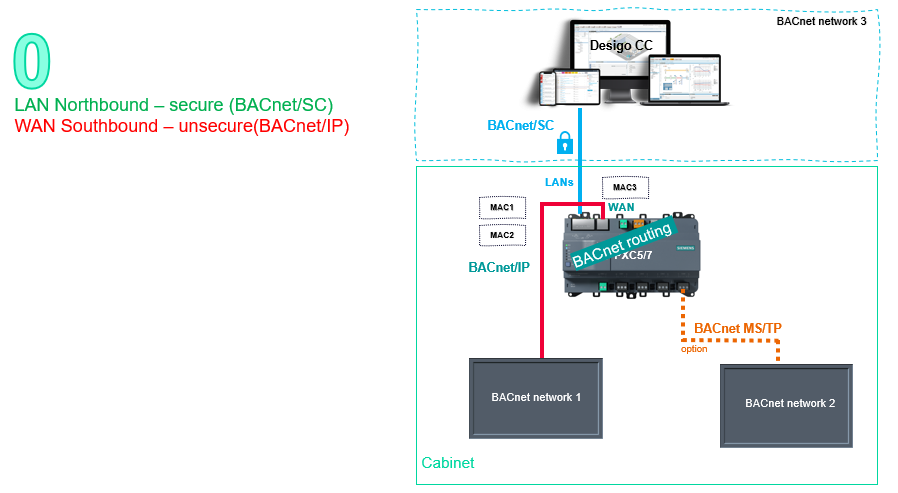

The WAN port has unencrypted BACnet/IP traffic and is not intended to external network access.
Case 1: Project extension with BACnet/SC communication
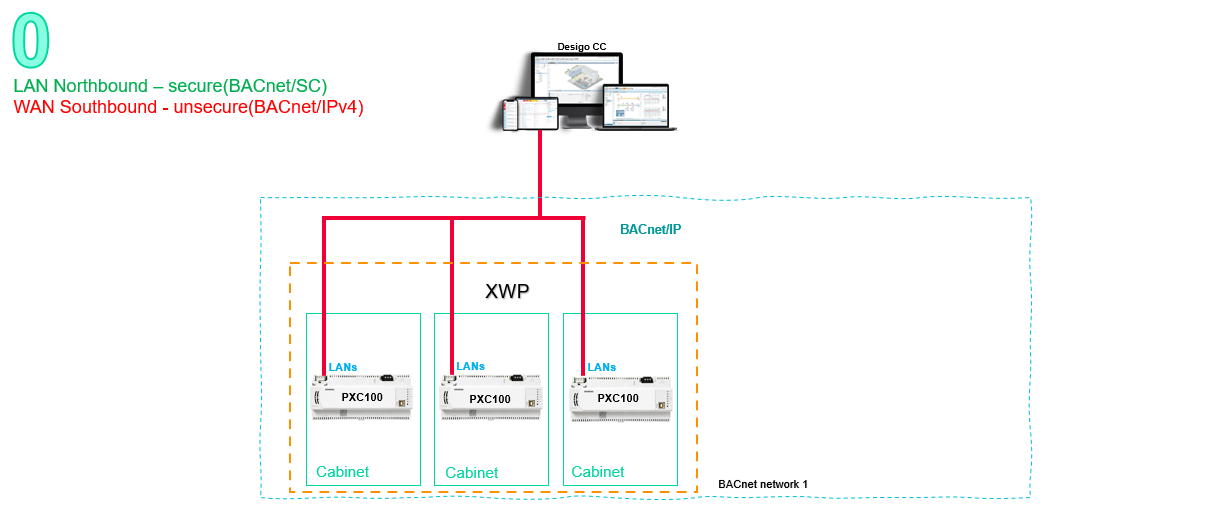
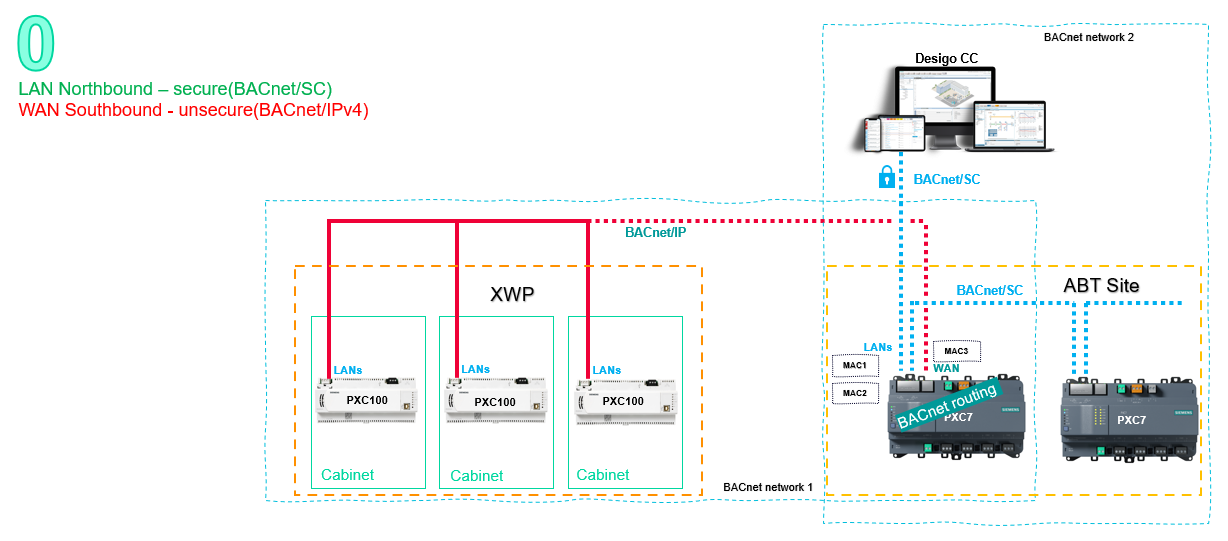
Using the extension in Desigo CC: Route the BACnet/IP network from existing devices via the WAN port to the PXC5/7 device and to Desigo CC over the BACnet/SC network on LAN port 1A. Use LAN port 1B to connect to other automation stations.
- Project before the extension
- Project after the extension
Security aspects:
- The BACnet/SC network ensures a high level of network security in the extended project area.
- Locked and controlled cabinet access protects the residual (and unsecure) BACnet/IP network.
Engineering and customer data:
- No additional graphical or data engineering is required for Desigo CC; existing data for trends, alarms, logs, etc. are not lost.
- Set up and operate the new BACnet/SC network.
- No additional engineering required for PXC00 ... PXC200 devices with Xworks Plus (XWP). Configure the PXC5/7 WAN port to use BACnet/IP and the LAN port to use BACnet /SC.
Financial aspects:
- Sets the groundwork for subsequent migration to PXC7 devices.
Case 2: Improve the network security outside the control cabinet
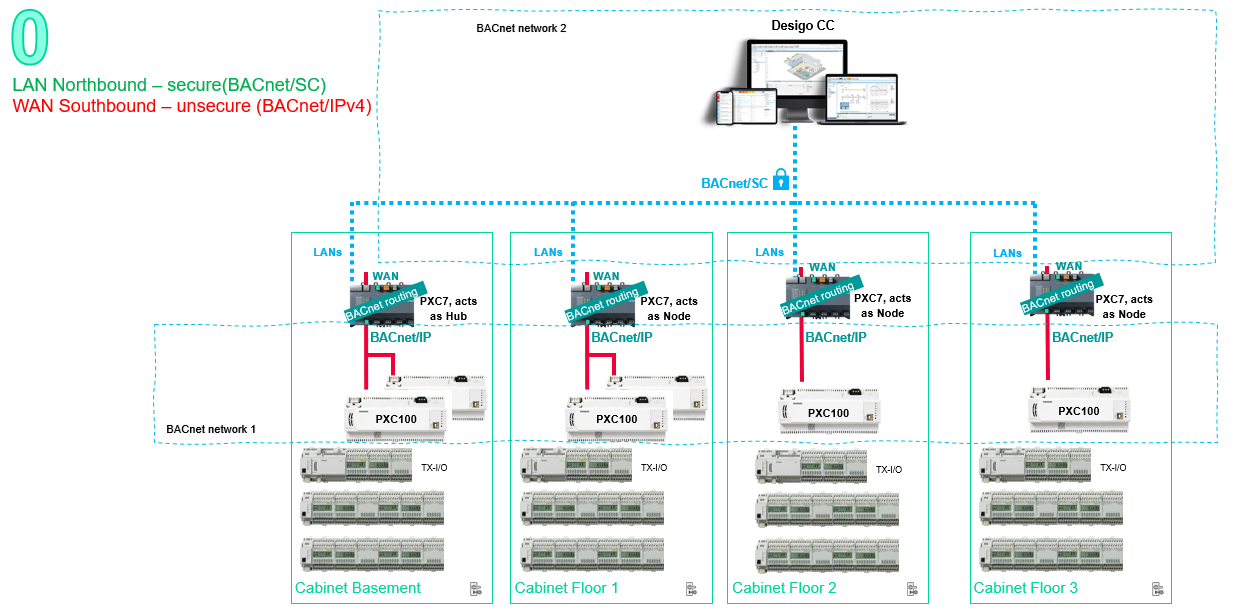
Install an PXC7 device at the top of the control cabinet and route all the traffic in the cabinet through the new device. The old devices still talk directly /IP to each other. The legacy devices connect to the PXC7 via BACnet/IP and the hub connects directly to Desigo CC.
Security aspects:
- The BACnet/SC network provides a high level of network security.
- A locked and controlled cabinet physically secures the unsecure BACnet/IP network from eavesdropping.
- Disable unused Ethernet ports.
Engineering and customer data:
- No additional engineering is required for Desigo CC. Only BACnet/SC must be configured on Desigo CC.
Financial aspects:
Protect your investment by replacing devices with PXC7:
- The PXC housing is the same size as the PXC100 ... PXC200.
- The Island bus connection is the same as the PXC100 ... PXC200
The PXC5.E003 cannot be used in this scenario (WAN) and the PXC5.E24 housing is larger than the PXC100 … PXC200.
Case 3: Replace existing PXC100 ... PXC200 devices with new PXC7 devices
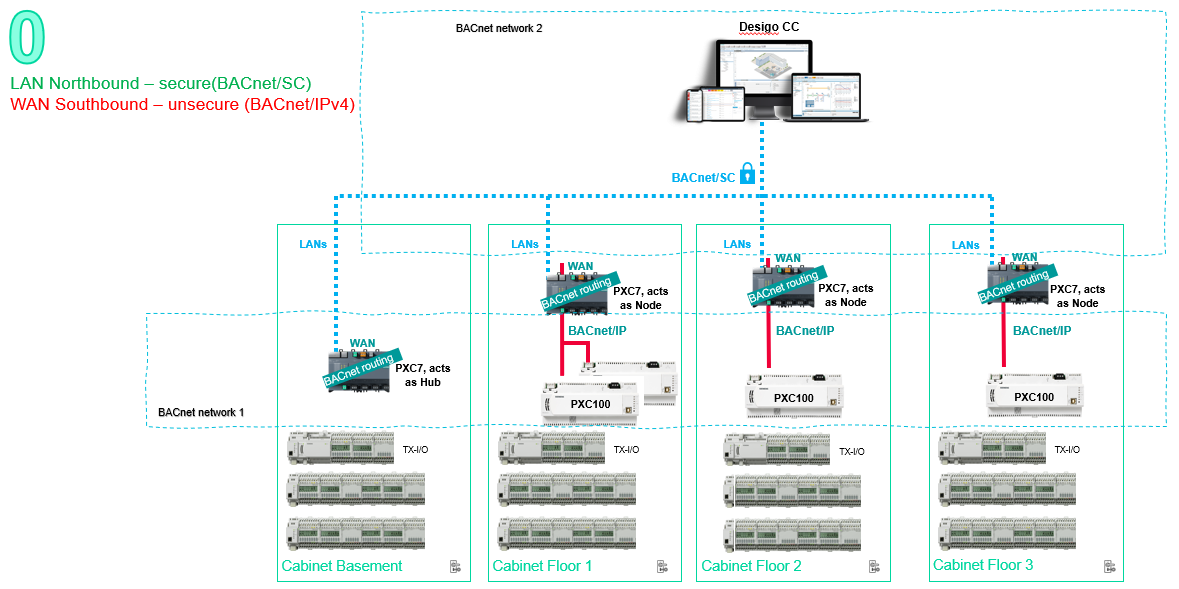
Replace existing PXC100 ... PXC200 devices with PXC7 devices. The PXC7 in the basement serves as the hub (cabinet basement) and PXC5/7 devices are added to the cabinets on floors 1 – 3 as nodes connected to the hub. The legacy devices communicate with the nodes and hub over BACnet/IP. This requires additional re-engineering to Desigo CC.
Security aspects:
- The BACnet/SC network provides a high level of network security.
- Disable unused Ethernet ports.
- A locked and controlled cabinet physically secures the unsecure BACnet/IP network from eavesdropping.
Engineering and customer data:
- The new application concept for the PXC7 control program requires re-engineering.
- Desigo CC data, such as trends, alarm routing, logs, etc. must be migrated for this device.
- New graphics required to replace existing Desigo CC graphics for this device.
Financial aspects:
- Existing TX-I/O’s can be used (no new wiring required).
- The costs of the new application program and commissioning must be considered in the bid.
- Desigo CC data must be migrated, and the costs considered in the bid.
Case 4: Replace an existing PXC100 ... PXC200 device with a new PXC7 device
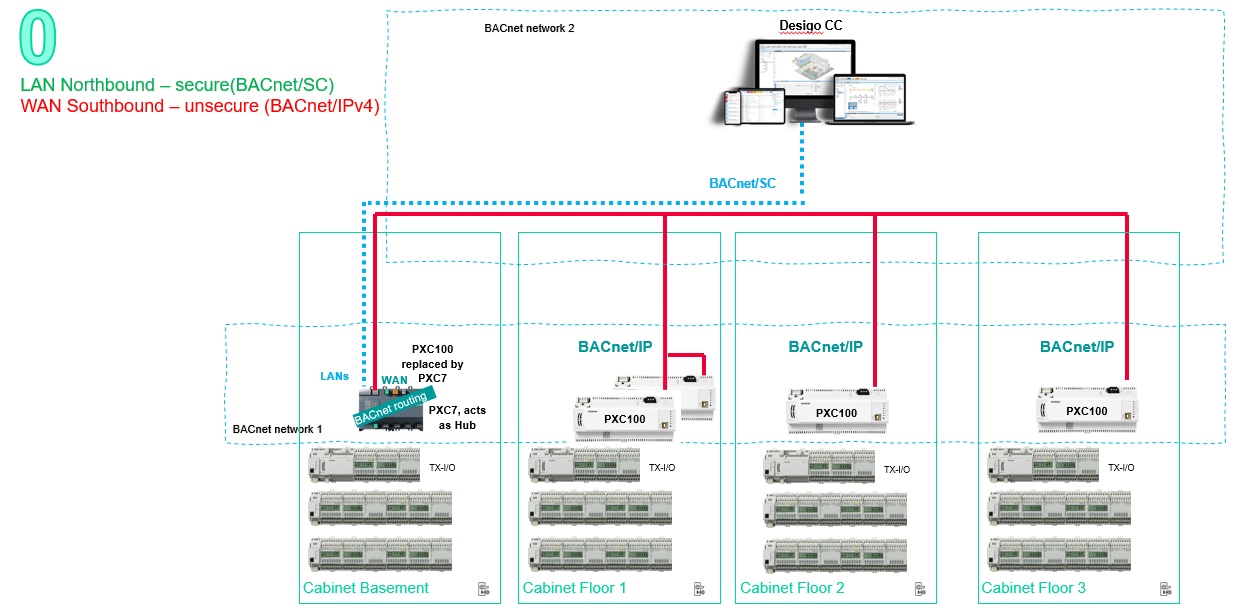
Replace an existing PXC100 ... PXC200 device with a PXC7 device (for example, in the basement) and route the other floors over BACnet/IP to the hub. Route communications to Desigo CC over BACnet/SC (LAN 1A) (requires additional re-engineering in Desigo CC). The cabinets on floors 1-3 remain unchanged.
Security aspects:
- The BACnet/SC network provides a high level of network security.
- Disable unused Ethernet ports (here the WAN port).
- The BACnet/IP network to cabinets on floor 1-3 are unsecure (same as before).
- A locked and controlled cabinet physically secures the unsecure BACnet/IP network from eavesdropping. Note: Cable outside of the cabinet are not secure and is in responsibility of the customers installation.
Engineering and customer data:
- The new application concept for the PXC7 control program requires re-engineering.
- Desigo CC data, such as trends, alarm routing, logs, etc. must be migrated for this device.
- New graphics required to replace existing Desigo CC graphics for this device.
Financial aspects:
- Existing TX-I/O’s can be used (no new wiring required).
- The costs of the new application program and commissioning must be considered in the bid.
- Desigo CC data must be migrated, and the costs considered in the bid.