RP_UNSG: Read unsigned property
RP_UNSG reads a specified property or array element value of datatype Unsigned from the data point.
Compatible data points:
- Any BACnet data point with a readable property or array element of datatype Unsigned.
Refer to data point objects for a detailed description of the BACnet data points.
NOTICE

Note
Some properties on remote devices may require up to 20 minutes (or a power-cycling of the remote device) for changes to be visible to the XFB. This does not include properties that the system relies upon for change of value notifications, such as Present value, State flag and Reliability.
Pin description (inputs)
BaObjRef | |
|---|---|
BA-Object reference Structure [BaObjRef] defines a bound connection between XFB and BACnet object. The binding occurs automatically. Manual configuration attempts are not necessary and can result in system errors. | |
DeviceId | Device identifier Double word (default value: 16#3FFFFF) [DeviceId] comprises object type and object instance in a single identifier. It is used to identify device object: local or remote. Local device object could also be identified by value 16#3FFFFF. |
ObjectId | Object identifier Double word (default value: 16#3FFFFF) [ObjectId] comprises object type and object instance in a single identifier. It is used to identify object within a device. |
ItemId | Item identifier Integer (default value: -1) [ItemId] represents an item index in the functional view node object, which references the BACnet object. [ObjectId] and [ItemId] together define an indirect access reference to the BACnet object. Value -1 indicates that direct binding is used. |
PrpyId |
|---|
Property identifier Integer (default value: 0) The parameterized BACnet Id number of the property being read. |
ArrayIdx | |
|---|---|
Array index Integer (default value: -1) Index number of the array element to be accessed by the XFB. [ArrayIdx] represents an optional parameterized input for specifying access to an element of a property of datatype BACnetARRAY or BACnetPriorityArray. [ArrayIdx] cannot be changed during runtime. | |
= -1 | [ArrayIdx] not used. |
= 0 | (0) specifies the length of the array of the referenced property. |
> 0 | Parameterized value. |
Pin description (outputs)
Val |
|---|
Value Double word (default value: 0) The value of the referenced property or array element. The XFB will deliver the last valid value if a previously accessible object / property is no longer accessible (for example, communication failure). |
TiVal |
|---|
Time value Time (default value: 0) The value of the referenced property or array element in TIME format. The resolution is in seconds and the value of the referenced property must be in range 0...2147483. If the value being read is greater than 2147483, [TiVal] will display an overflow maximum value: 24d 20h 31m 23s 647ms. The XFB will deliver the last valid value if a previously accessible object/property is no longer accessible (for example, communication failure). |
ReadVld | |
|---|---|
Read valid Boolean (default value: False) An indication of whether the referenced property is accessible and readable. The referenced property must be of the XFB specified datatype. [ReadVld] is not dependent on reliability. | |
1 (True) | The referenced property is accessible and readable. |
0 (False) | The referenced property cannot be accessed or read. |
PrioAct | |
|---|---|
Priority active Boolean (default value: False) An indication of whether the priority array element queried by [ArrayIdx] contains a valid commanded value or is relinquished (NULL). Note | |
1 (True) | The queried priority is commanded. |
0 (False) | The queried priority is relinquished (NULL), or the referenced property is not a priority array element. |
ErrCode | |
|---|---|
Error code indication Integer (default value: 20) The status of the last performance of the XFB read operation. | |
= 0 | No error. |
> 0 | Error, see XFB error codes. |
Use case examples
NOTICE
Note
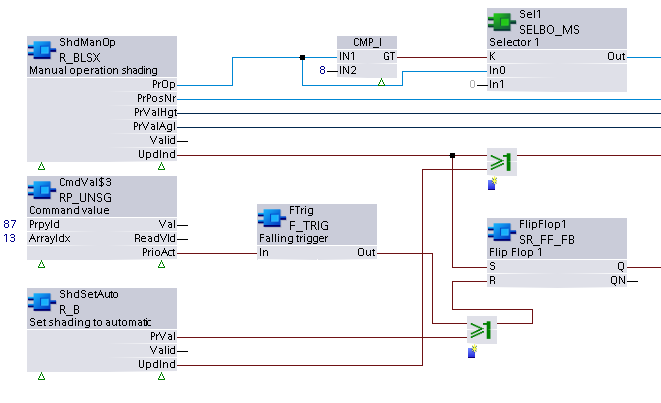
Graphics reflect examples of XFB implementations; See ABT for current examples of CFC.
Central push button operation for a group of blinds: Example taken from the Central shading function AFN{CenOpShd01}. Due to graphical size limitations, function blocks may be missing or shown more closely grouped than is typical.