FILTER: Attenuation filter
The FILTER (FB427) block attenuates the input signal by a first-order low-pass filter.
Functionality
The following functions are integrated in the block:
- Adjustable attenuation by means of a time constant.
- Input value applied to the output via reset pulse.
If the input value [In] jumps at time t0 from 0 to 1, the output [Out] (at time t0: [Out] = 0) issues an exponential response as per function1–e-(t-t0)/TiCon, t ≥ t0, where t is the current time and [TiCon] the time constant. The greater [TiCon], the longer the time the output requires to apply the input value. The duration is approximately five times the time constant.
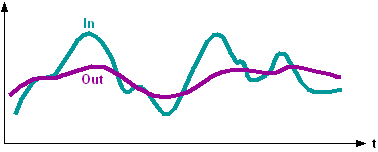
Sensor signal (In), filtered signal (Out)
Enabling and disabling the function
When [EnFnct] = 1 (Yes), the function is enabled.
When [EnFnct] = 0 (No), the function is disabled. No new input values are acquired and calculation is stopped. The last value is available at output [Out].
Reset
When [Reset] = 1 (Yes), input [In] is issued at output [Out].
Inputs
Pin | E | Description | |
EnFnct | p | Enable function. | |
1 (Yes) | The function is enabled. | ||
0 (No) | The function is disabled. | ||
In | pa | Input. | |
Reset | p | Reset. | |
1 (Yes) | [Out] = [In]. | ||
0 (No) | The function is operating. | ||
TiCon | pa | Time constant. [TiCon] should be greater than 10s. In the special case where [TiCon] = 0, the filter output immediately follows the filter input. | |
Outputs
Pin | E | Description |
Out | a | Output. Attenuated signal. |
Input values
Pin | Description | Data type | Default value | E.g. Engineering unit or Text group | Min. | Max. |
EnFnct | Enable function. | Boolean | 1 (Yes) | No, Yes |
|
|
In | Input. | Real | 0.0 |
| -3.403E38 | 3.403E38 |
Reset | Reset. | Boolean | 0 (No) | No, Yes |
|
|
TiCon | Time constant. | Time | 10s | T#0d_0h_0m_0s_0ms |
|
|
Output values
Pin | Description | Data type | Default value | E.g. Engineering unit or Text group | Min. | Max. |
Out | Output. | Real | 0.0 |
| -3.403E38 | 3.403E38 |
Application
The attenuation filter is used to attenuate signals having unwanted, fast changes. It allows for suppressing e.g. fluctuations or measured variable differences.
Process response
During the first cycle in the process, the filtered value is initialized with the input value and transmitted to the output. Filtering does not start until the second cycle in the process.
Troubleshooting
Standard (see General rules and information).