LIMIT_R: Limit of real value
The LIMIT_R (FB455) block limits a real number to two upper and two lower limit values.
Functionality
The block limits the value at input [In] to the upper limit 1 [HiLm1], the lower limit 1 [LoLm1], the upper limit 2 [HiLm2], and the lower limit 2 [LoLm2].
When the respective limits are reached or exceeded, the associated output [HiLm1Rd], [LoLm1Rd], [HiLm2Rd], and [LoLm2Rd] is set. The output is reset as soon as the limit +/- hysteresis is no longer reached. The hysteresis can be parameterized separately for limit value pair 1 [Hys1] and for limit value 2 [Hys2].
The limit value supervisions are enabled via input [EnFnct] = 1 (Yes). With [EnFnct] = 0 (No), the outputs are switched off and the times reset.
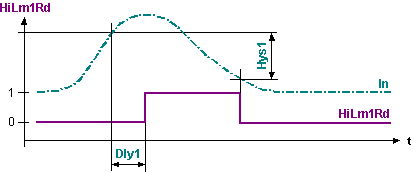
Limit value supervision can have time delays. The associated outputs are set only if the limit value violation exceeds the parameterized delay time. [Dly1] then applies to limit value pair1 and [Dly2] to limit value pair 2. The outputs are reset without delay.
Standard setting
Even though the individual limits can be used and arranged as needed, limit value pair 2 normally is used for large deviations from the normal value (e.g. as a danger limit), and limit value pair 1 for slight deviations from the normal value (e.g. warning limit). The following order then results: [LoLm2] < [LoLm12] < Normal value < [HiLm1] < [HiLm2].
Diagrams
Diagrams 1 to 4 represent the response without time delay (Dly1 = Dly2 = 0 sec).
Diagram 1 : Response of output [HiLm1Rd].
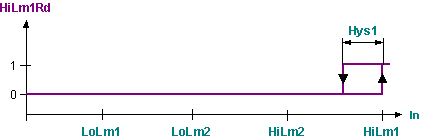
Diagram 2 : Response of output [HiLm2Rd].
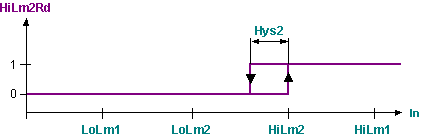
Diagram 3 : Response of output [LoLm2Rd].
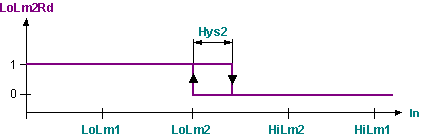
Diagram 4 : Response of output [LoLm1Rd].
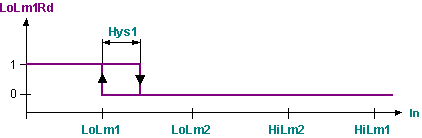
Diagram 5 : Time-related response of [HiLm1Rd] at given response of [In].
Inputs
Pin | E | Description |
EnFnct | p | Enable function. 1 (Yes): The function is enabled. 0 (No): The function is disabled. With [EnFnct] = 0, all outputs are reset. |
In | pa | Input. Analog input value (e.g. measured value). |
HiLm2 | pa | High limit 2. Value for the upper limit of limit value pair 2. |
HiLm1 | pa | High limit 1. Value for the upper limit of limit value pair 1. |
LoLm1 | pa | Low limit 1. Value for the lower limit of limit value pair 1. |
LoLm2 | pa | Low limit 2. Value for the lower limit of limit value pair 2. |
Hys1 | pa | Hysteresis 1. A violation of the upper limit 1 is reset if [In] < [HiLm1] - [Hys1]. A violation of the lower limit 1 is reset if [In] > [LoLm1] + [Hys1]. |
Hys2 | pa | Hysteresis 2. A violation of the upper limit 2 is reset if [In] < [HiLm2] - [Hys2]. A violation of the lower limit 1 is reset if [In] > [LoLm2] + [Hys2]. |
Dly1 | pa | Delay control limits 1. The outputs [HiLm1Rd] and [LoLm1Rd] are set only if the limit value violation exists for more than [Dly1]. |
Dly2 | pa | Delay control limits 2. The outputs [HiLm2Rd] and [LoLm2Rd] are set only if the limit value violation exists for more than [Dly2]. |
Outputs
Pin | E | Description |
HiLm2Rd | a | High limit 2 reached. The upper limit 2 was reached or exceeded for more than [Dly2]. |
HiLm1Rd | a | High limit 1 reached. The upper limit 1 was reached or exceeded for more than [Dly1]. |
LoLm1Rd | a | Low limit 1 reached. The lower limit 1 was reached or violated for more than [Dly1]. |
LoLm2Rd | a | Low limit 2 reached. The lower limit 2 was reached or violated for more than [Dly2]. |
Input values
Pin | Description | Data type | Default value | E.g. Engineering unit or Text group | Min. | Max. |
EnFnct | Enable function. | Boolean | 1 (Yes) | No, Yes |
|
|
In | Input. | Real | 0.0 |
|
|
|
HiLm2 | High limit 2. | Real | 0.0 |
|
|
|
HiLm1 | High limit 1. | Real | 0.0 |
|
|
|
LoLm1 | Low limit 1. | Real | 0.0 |
|
|
|
LoLm2 | Low limit 2. | Real | 0.0 |
|
|
|
Hys1 | Hysteresis 1. | Real | 0.0 |
|
|
|
Hys2 | Hysteresis 2. | Real | 0.0 |
|
|
|
Dly1 | Delay control limits 1. | Time | 0ms | T#0d_0h_0m_0s_0ms |
|
|
Dly2 | Delay control limits 2. | Time | 0ms | T#0d_0h_0m_0s_0ms |
|
|
Output values
Pin | Description | Data type | Default value | E.g. Engineering unit or Text group | Min. | Max. |
HiLm2Rd | High limit 2 reached. | Boolean | 0 (No) | No, Yes |
|
|
HiLm1Rd | High limit 1 reached. | Boolean | 0 (No) | No, Yes |
|
|
LoLm1Rd | Low limit 1 reached. | Boolean | 0 (No) | No, Yes |
|
|
LoLm2Rd | Low limit 2 reached. | Boolean | 0 (No) | No, Yes |
|
|
Application
Limit value supervision of measured values with two limit value pairs for control tasks. Subsequent alarm blocks also allow for conducting alarm supervision tasks.
Process response
During startup, all old values and present delays are reset. This means that the outputs are set only if the associated limits are violated and the time delays expired. The block then is processed with the values at the respective inputs. Depending on the processing order, the values either represent output values calculated by previously enabled blocks or instance-specific default values of the block.
Troubleshooting
Standard (see General rules and information).