RTHLD: Thermal room load analysis
Block RTHLD (FB861) calculates the thermal room load condition based on part heat and refrigeration demand signals as well as past minimum and maximum room temperatures.
Application: The determined thermal room load condition (load, unload) is used in particular for blinds control in the room to passively use solar heat or to protect against solar heat (e.g. Chart {RThLd01}). RTHLD_SiUn (FB861), RTHLD_UsUn (FB799)
Principle of operation
Step | Process |
1 | The last heat state [HCSta] = Heating is evaluated.
|
The last cooling state [HCSta] = Cooling is evaluated.
| |
2 | Deviation of the minimum room temperature [TRMin] to the heating setpoint for comfort [SpHCmf] is calculated during the past time period [TiPrd]:
|
Deviation of the maximum room temperature [TRMax] to the cooling setpoint Comfort [SpCCmf] is calculated during the past time period [TiPrd]:
| |
| The thermal room load condition is calculated (see Function description). The following values are outputted as the result:
|
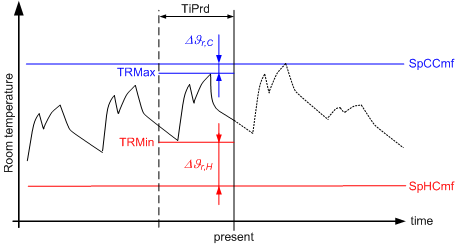
Function description of thermal room load condition
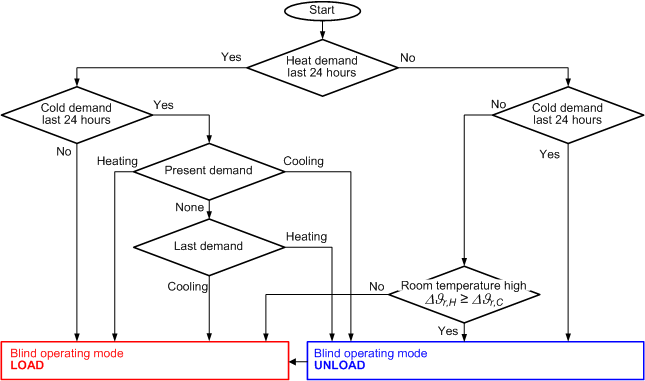
Heating demand
The thermal room load condition is set to load if only one heating demand (without cooling demand) existed within [TiPrd]. Even if no heating demand currently exists, the function assumes that a heating demand will occur in the future (persistency forecast).
Systems such as blinds can thus support heating.
Cooling demand
The thermal room load condition is set to unload if only one cooling demand (without heating demand) existed within [TiPrd]. Even if no cooling demand currently exists, the function assumes that a cooling demand will occur in the future (persistency forecast).
Systems such as blinds can thus support cooling.
No heating demand, no cooling demand
Room temperature measurement determine the thermal room load condition if no heating demand and no cooling demand existed within [TiPrd]:
The thermal load condition is set to unload if the room temperature is in the upper range of the Comfort room temperature setpoint range (condition Δϑr,H ≥ Δϑr,C).
At Δϑr,H < Δϑr,C, the thermal room load condition is set to load.
Systems such as blinds can thus affect maintaining the room temperature in the middle of the Comfort room temperature setpoint range as much as possible.
heating demand AND cooling demand
The thermal room load condition is determined by last demand if both a heating demand AND a cooling demand existed within [TiPrd]:
- The thermal room load condition is set to load if a heating demand currently exists.
- The thermal room load condition is set to unload if a cooling demand currently exists.
- The thermal room load condition is set to unload if no demand currently exists and the last occurring demand was a heating demand. This is based on the assumption that heating and cooling will change within [TiPrd] and continue to do so in the future as well. As a result, systems such as blinds should always be ready to anticipate the next demand.
- The thermal room load condition is set to load if no demand currently exists and the last occurring demand was a cooling demand. This is based on the assumption that heating and cooling will change within [TiPrd] and continue to do so in the future as well. As a result, systems such as blinds should always be ready to anticipate the next demand.
Example: Using blinds control to implement thermal load condition (not a component of the function).
If thermal load state is equal to load, blinds take advantage of solar radiation during the day (i.e. blinds should be opened as much as possible) and prevent heat flow from the room to the environment during the night (i.e. blinds should be closed as much as possible).
If thermal room load state is equal to unload, blinds should prevent solar radiation during the day (i.e. blinds should be closed as much as possible) and permit heat flow from the room to the environment during the night (i.e. blinds should be opened as much as possible).
Pin description
Pin | Description | |
HCSta | Heating/cooling state | |
Neither nor | No (present) heating or cooling demand | |
Heating | (Present) heating demand | |
Cooling | (Present) cooling demand | |
TiPrd | Time periods | |
SpCCmf | Cooling setpoint for comfort | |
SpHCmf | Heating setpoint for comfort | |
TRMax | Maximum room temperature | |
TRMin | Minimum room temperature | |
RThLdCnd | Thermal room load condition | |
Load | The room has the thermal room load condition load: | |
Unload | The room has the thermal room load condition unload: | |
TiEldHeat | Expired time heating | |
TiEldCool | Expired time cooling | |
Input values
Pin | Description | Data type | Standard value | Engineering unit or text group | Min. | Max. |
HCSta | Heating/cooling state | INT | 1 | Neither heating/cooling. | 1 | 3 |
TiPrd | Time period | TIME | T#1D_0H_0M_0S_0MS |
|
|
|
SpCCmf | Cooling setpoint for comfort | REAL | 24.0 | °C | 10.0 | 35.0 |
75.0 | °F | 50.0 | 95.0 | |||
SpHCmf | Heating setpoint for comfort | REAL | 21.0 | °C | 10.0 | 35.0 |
70.0 | °F | 50.0 | 95.0 | |||
TRMax | Maximum room temperature | REAL | 22.5 | °C | 10.0 | 35.0 |
72.5 | °F | 50.0 | 95.0 | |||
TRMin | Minimum room temperature | REAL | 22.5 | °C | 10.0 | 35.0 |
72.5 | °F | 50.0 | 95.0 |
Output values
Pin | Description | Data type | Standard value | Engineering unit or text group | Min. | Max. |
RThLdCnd | Thermal room load condition | INT | 2 | Load, Unload | 2 | 1 |
TiEldHeat | Expired time heating. | TIME | T#0D_0H_0M_0S_0MS |
|
|
|
TiEldCool | Expired time cooling. | TIME | T#0D_0H_0M_0S_0MS |
|
|
|
Engineering
Typical interconnections to other blocks
Pin | Description |
HCSta | The present heating/cooling demand of the room is reported to the block via this input. Heating/cooling demand for the zone can be interconnected if heating and/or cooling is not based on individual room control. |
TiPrd | This input is not typically interconnected. The setting value is usually left at the default value of 24 hours. |
SpCCmf | The present, valid comfort room temperature setpoint for cooling is interconnected to this input. |
SpHCmf | The present, valid comfort room temperature setpoint for heating is interconnected to this input. |
TRMax | This input must be interconnected with the maximum room temperature of the past time period [TiPrd]. |
TRMin | This input must be interconnected with the minimum room temperature of the past time period [TiPrd]. |
RThLdCnd | This output is typically further interconnect to the control logic for the blinds. |
TiEldHeat | Output is used for diagnostics and typically not interconnected. |
TiEldCool | Output is used for diagnostics and typically not interconnected. |
Use
The function is used in HVAC applications to support heating and cooling and their operation (at nearly) no cost. Such systems include blinds or heat recovery units in ventilation plants. These type of HVAC applications can also control active heating and cooling systems.
The function ensures for present heating and cooling demand that such systems support the present demand. Moreover, the function ensures that such systems operate in a supporting manner if no present heating and cooling demand exists.
Note: The function should not be used, if operating the supporting systems is less expensive than active heating or cooling, but not free of charge. Other calculations are generally required for such systems, e.g. free cooling using a cooling tower.
Process response
Standard (see General rules and information).
Troubleshooting
Standard (see General rules and information).