Electric radiator, staged with downdraft compensation (RadEl12)
| This application function operates electric radiator(s) and supports downdraft compensation. The radiator electric position is calculated based on a request signal for heating (from a room controller). Multiple radiator control is supported. There is an optional binary input for the radiator overtemperature detector. This application function is NOT available for: |
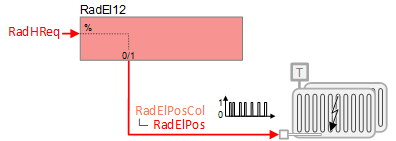
Required elements and how to configure them:
Element | I/O | Signal type |
|---|---|---|
RadElPos "Radiator electric position" | On-board output, Radiator valve position 1 | Electric 1-stage Normally open |
 WARNING

Electric heat coils require safety limit thermostat
Improper installation of electric heating coils can result in fire and cause destruction of life and property.
- Install a high temperature cut-out switch on all electric heating elements.
- Ensure that all wiring and installation conform to applicable safety codes and regulations.
Function
The figure below shows BACnet objects associated with this application function. Primary signal flow is summarized as follows:
Radiator heating request (RadHReq) is received and processed into binary output signal for radiator electric position (RadElPos).
Basic function: Accept request signal from associated room controller and pass it through a device mode logic switch; Output the result as a command to the BACnet object that controls the device.
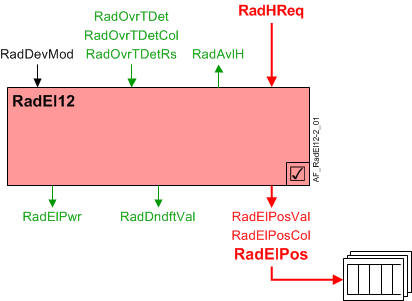
| Command or request (or related) |
| Notification of condition or status, or availability |
| Device mode |


Binary control of electric radiator, single stage operation: In response to heating demand, the radiator electric position (RadElPos) is switched on/off to control the room temperature at setpoint. It also can be commanded in response to external trigger(s) for special modes such as warm-up or cool down, or safety conditions.
Note
This AF does not perform loop control; its main purpose is to run commands. Loop control processes (for this AF) are managed in the "room" AF(s) that collaborate with this AF to command the end device.
Multiple radiator control: The radiator electric position collection object (RadElPosCol) can reference and control multiple radiators.
Radiator electric position objects (RadElPos) are referenced by the radiator electric position collection object (RadElPosCol); this collection object is a common node for any / all RadElPos object(s). The value for RadElPos comes from RadElPosVal.
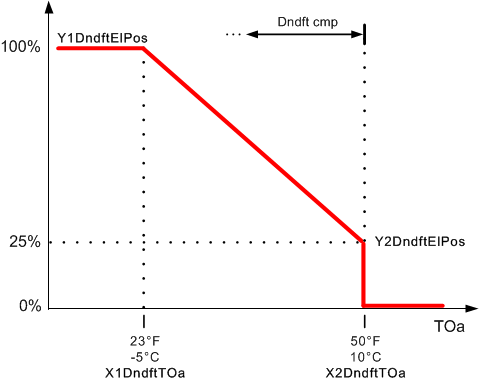
Downdraft compensation: The downdraft compensation feature slows the sinking cold air flow at large window surfaces and combats cold wall effect at cold perimeter surfaces. This feature activates the radiator when the outside air temperature drops below a configured value, raising the minimum temperature of the radiator to a value higher than it would be otherwise.
Downdraft compensation is implemented using a linear reset function. The following graphic shows factory default values for X,Y downdraft compensation parameters.
Parameter EnDndft must be set to 1:Yes for downdraft compensation to function (see Configuration).
Device mode: The input signal for device mode is a multistate value.
RadDevMod supports the following states:
- Off
- Control mode (modulation)
- Fully open
- Ctrl.mode & downdraft (modulation plus downdraft compensation)
- Downdraft (downdraft compensation)
Heating available status: When the radiator(s) are available for heating, the binary output signal for "Radiator available for heating" (RadAvlH) will be "Yes" (available). RadAvlH is used by the system to regulate heating resources. For example, if there is a call for heating but the radiator(s) are not available because they are already at maximum capacity (because device mode is fully open), then RadAvlH will signal "No" and the next available heating resource in the temperature control sequence will be activated.
For heating available status to be "Yes", device mode must equal "Control mode" (modulation).
High temperature cut-out switch: This AF has a radiator over-temperature detection input (RadOvrTDet) from a high temperature cut-out switch. The over-temperature detection input object(s) are referenced by the radiator over-temperature detection collection object (RadOvrTDetCol); this collection object is a common node for any/all RadOvrTDet input object(s).
The RadOvrTDet objects are analyzed using an OR statement. If one or more objects detect over temperature, the binary result object (RadOvrTDetRs) switches from 0 to 1, causing the radiator to shut off at equipment protection priority.
Electric power usage: The nominal electric power usage of the electric radiator is provided for energy monitoring and coordination with other devices. The following equation calculates the radiator's electric power usage when on (RadElPosVal > 0%):
RadElPwr = RadElPosVal * NomElPwr (zero power is used when radiator is off)
Configuration
 Parameters
Description | Parameter | Default value |
|---|---|---|
Nominal electric power | NomElPwr | 0.4 [kW] |
Enable overtemperature detector input 0:No | EnOvrTDetIn | 0:No |
Downdraft compensation | ||
Enable downdraft compensation 0:No | EnDndft | 0:No |
Downdraft characteristics for outside air temperature X1 | X1DndftTOa | -5 [°C], 23.0 [°F] |
Downdraft characteristics for electric position Y1 | Y1DndftElPos | 100 [%] |
Downdraft characteristics for outside air temperature X2 | X2DndftTOa | 10 [°C], 50.0 [°F] |
Downdraft characteristics for electric position Y2 | Y2DndftElPos | 25 [%] |
Internal settings – do not change | ||
Temperature unit | TUnit | [°C] |
Interface
Interface | Description | Type | Ref. | Owned by | |
|---|---|---|---|---|---|
RadElPosCol | Collection of radiator electric position | ColView | ● | - | |
| RadElPos | Radiator electric position (1...n) | BO | ◉ | Room segment / Device |
RadElPosVal | Radiator electric position value 0:Off | BPrcVal | ● | - | |
RadOvrTDetCol | Collection of radiator overtemperature detector | ColView | ● | - | |
| RadOvrTDetRs | Result of radiator overtemperature detector 0:Off | BCalcVal | ● | - |
RadOvrTDet | Radiator overtemperature detector (1...n) 0:Off | BI | ◉ | Room segment / Device | |
RadDevMod | Radiator device mode 1:Off | MPrcVal | ● | - | |
RadHReq | Radiator heating request | ACalcVal | ● | - | |
RadAvlH | Radiator available for heating 0:No | BCalcVal | ● | - | |
RadDndftVal | Radiator downdraft value | ACalcVal | ● | - | |
RadElPwr | Radiator electric power | ACalcVal | ● | - | |
Engineering and commissioning
If one high temperature safety switch trips, all the radiators driven by this AF shut down. Confirm function of safety switch for multiple radiators (multiple in and multiple out).
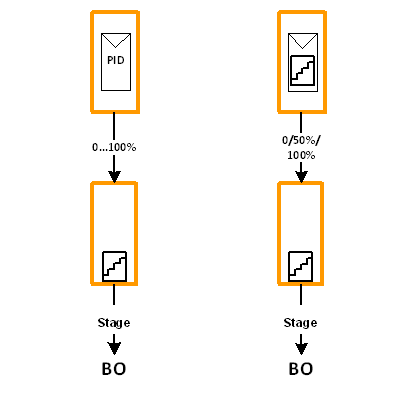
Design engineer may choose the type of output to the radiator(s). The logic to create each output type is embedded in the controller. There are two types of output:
- PID loop creates 0 to 100% analog heating demand signal to drive the electric radiator(s)
- PID loop creates 0 / 50 / 100% staged signal to drive the electric radiator(s)