[CONT_4ST] Step switch for four stages
Function block CONT_4ST determines the resultant switching stage for a multistage component in dependence of an analog input value.
CONT_4ST determines the resultant switching stage for a multistage component in dependence of an analog input value.
Four switch-on thresholds and four hystereses can be parameterized.
CONT_4ST determines the requested setpoint stage [SpSt] in dependence of the analog value [In].
Direct acting ([Actg] = 0)
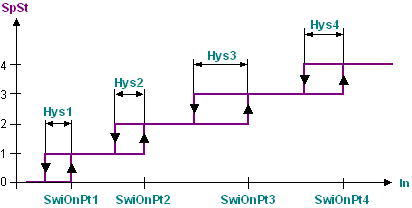
If the direction of control action is direct ([Actg] = 0), a higher stage is requested for an increasing input value [In]. The switch-on points are then parameterized in the following order: [SwiOnPt1] < [SwiOnPt2] < [SwiOnPt3] < [SwiOnPt4].
If [In] ≥ [SwiOnPt1], then the requested setpoint stage is [SpSt] 1. If [In] ≥ [SwiOnPt2], then 2, etc. If [In] is below the switch-on points [SwiOnPt1]...[SwiOnPt4] - Hysteresis [Hys1]...[Hys4], the stages are reset. If this sequence is not adhered to, CONT_4ST sets the switch-on points accordingly.
Reverse acting ([Actg] = 1)
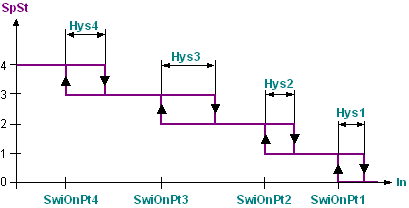
If the direction of control action is reverse ([Actg] = 1), a lower stage is requested for an increasing input value [In]. The switch-on points are then parameterized in the following order: [SwiOnPt4] < [SwiOnPt3] < [SwiOnPt2] < [SwiOnPt1].
If [In] ≤ [SwiOnPt1], then the requested setpoint stage is [SpSt] 1. If [In] ≤ [SwiOnPt2], then 2 etc. If [In] is above the switch-on points [SwiOnPt1]...[SwiOnPt4] + Hysteresis [Hys1]...[Hys4], the stages are reset. If this sequence is not adhered to, CONT_4ST sets the switch-on points accordingly.
Adding up an additional value
The offset [Ofs] allows for adding an additional value to [SpSt].
Switch-on and switch-off delay
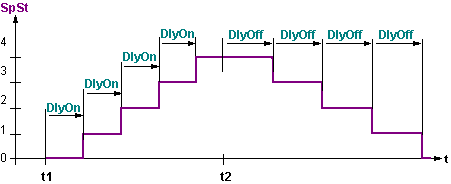
Switching on and off is delayed ([DlyOn], [DlyOff]). The switch-on or switch-off delays are set for each stage. Only one stage can be switched on or off at a time.
Min. runtime and min. pause time
Additionally, a minimum runtime per stage [TiRnMin] and a minimum pause time per stage [TiOffMin] can be parameterized. These times cause the stage to run for at least the indicated time after switch-on or to be switched off for at least the indicated time.
Reach highest or lowest stage
- If the highest stage is reached (by including switch-on delay and min. pause time), output [ReqHi] = 1.
- If the lowest stage is reached and switched back completely (by including switch-off delay and min. switch-on time), output [ReqLo] = 1.
Switch off or run function
The function can be fully disabled via [EnFnct] = 0. When [EnFnct] = 0, the output [SpSt] and all times are reset regardless of a possibly started minimum runtime. When [EnFnct] = 1, the function is run.
Enable ramp-up and ramp-down
- If [EnHi] = 1, ramp-up is enabled.
- If [EnLo] = 1, ramp-down is enabled.
Switching in sequence multiple CONT_4ST
If 4 possible stages or components are insufficient, several CONT_4ST function blocks can be switched in sequence. In this case, the delay times can be used for each individual block CONT_4ST (e.g. two separate, 4-stage E-heating coils) or for several CONT_4ST (e.g. 8-stage heating coils).
Example for [Actg] = 0 (direct) and [Ofs] = 0
Example for [Actg] = 1 (reverse) and [Ofs] = 0
Time response for switch-on and switch-off delays
At t1, [In] moves from ≤ [SwiOnPt1] to [SwiOnPt4].
At t2, [In] moves from [SwiOnPt4] to ≤ [SwiOnPt1] - [Hys1].
Input | Description | Data type | Default value |
|---|---|---|---|
EnFnct | Enable function Enables the function. | Boolean | 1 |
0 - The function is disabled. | |||
In | Input Value used to derive the switching state. | Real | 0.0 |
SwiOnPt1…SwiOnPt4 | Switch-on point 1…Switch-on point 4 Switching threshold for switch-on for stage 4 | Real | 0.0 |
Hys1…Hys4 | Hysteresis 1…Hysteresis 4 | Real | 0.0 |
Actg | Control action Determines the relationship between manipulated and control variable. | Boolean | 1 |
0 - Direct effect, such as cooling or dehumidification. | |||
DlyOn | Switch-on delay Waiting time until the stage is actually switched after the stage request is sent. | Time | 0 ms |
DlyOff | Switch-off delay Waiting time until the stage is actually switched off after the stage request reset is sent. | Time | 1m_40s |
TiRnMin | Minimum runtime Minimum time during which an enabled stage must be switched on. | Time | 1m_40s |
TiOffMin | Min.switch-off time Minimum time during which a disabled stage must be switched off. | Time | 0 ms |
EnHi | Enable step-up | Boolean | 1 |
0 - Ramp-up disabled. | |||
EnLo | Enable step-down | Boolean | 1 |
0 - Ramp-down disabled. | |||
Ofs | Offset Fixed value added to output [SpSt]. | Integer | 0 0…8 |
NumSts | Number of stages | Integer | 4 0…4 |
Output | Description | Data type | Default value |
|---|---|---|---|
SpSt | Setpoint stage Required stage as an integer value to switch a multistage component. | Integer | 0 |
ReqHi | Request higher Highest possible switching stage or last component reached. | Boolean | 0 |
0 - Highest possible switching stage not reached. | |||
ReqLo | Request lower Switching stage Off reached or all components switched off. | Boolean | 0 |
0 - Not switched off fully. | |||
CONT_4ST can switch components to various stages in dependence of an analog value. These stages e.g. are multistage heating coils as actuators of temperature control or multistage fans in dependence of an air quality sensor.
During startup, all times are restarted. If the input value [In] requests a higher stage, the lower stages are run in sequence as shown in diagram 3. CON_4ST is then processed by the values at the inputs. Depending on the processing sequence, these are output values calculated by preceding function blocks or instance-specific default values of CONT_4ST.