[FILTER_H] Backlash
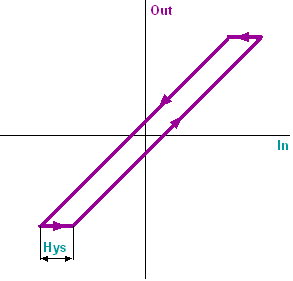
Function block FILTER_H generates an output variable in dependence of the set hysteresis band.
FILTER_H generates an output variable in dependence of the set hysteresis band.
The output variable stays at a default value until the input variable has passed through hysteresis following a change of direction. The input value influences the output value if half of the hysteresis has been passed by the input value.
Integrated functions
- Adjustable hysteresis band
- Input value applied to the output via reset pulse.
Enabling and disabling the function
- When [EnFnct] = 1, the function is switched on.
- When [EnFnct] = 0, the function is switched off.
No new input values are acquired and calculation is stopped. The last value is available at output [Out].
Reset
When [Reset] = 1, input [In] is issued at output [Out].
Input | Description | Data type | Default value |
|---|---|---|---|
EnFnct | Enable function Enables the function. | Boolean | 1 |
0 - The function is disabled. | |||
In | Input | Real | 0.0 |
Reset | Reset | Boolean | 0 |
0 - Do not reset | |||
Hys | Hysteresis | Real | 1.0 |
Output | Description | Data type | Default value |
|---|---|---|---|
Out | Output For an increasing input variable [In]: Output [Out] = Input [In] – ½ hysteresis [Hys]. | Real | 0.0 |
Typical applications are: Filtering of noise in signals (unstable input signals from pressure sensors, temperature sensors). Furthermore, the hysteresis filter is used to stabilize cascades with large gain, used in 2-point switches with small switching difference and control loops with external shifts.
Value 0 is provided at the output in the first process cycle. Input [Reset] is ignored in the first process cycle. In the second process cycle, the filtered value is initialized with value [In] and provided at the output. Filtering takes place for the first time from the third process cycle.