[SWI_DLY] Switch-on delay, switch-off delay
Function block SWI_DLY processes the input signal.
SWI_DLY processes the input signal. The following options exist:
- Delay switch-on or switch-off.
- Cancel switch-on signal.
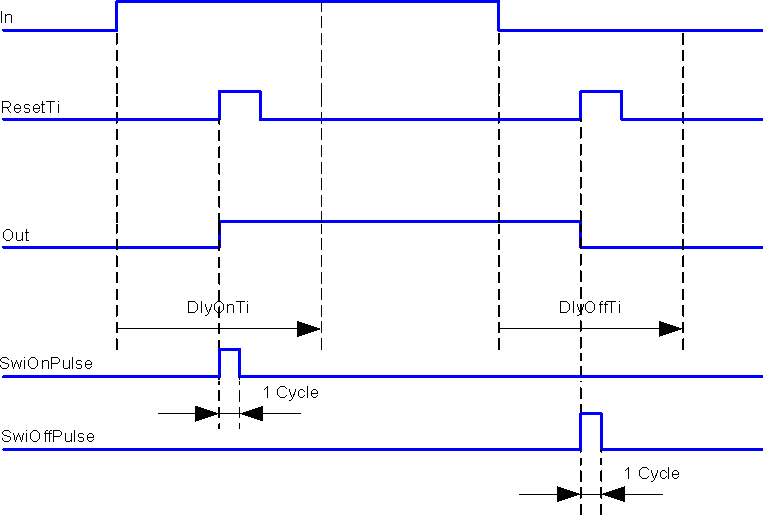
- Cancel delay times.
- Generate switch-on pulse or switch-off pulse.
Delay switch-on or switch-off.
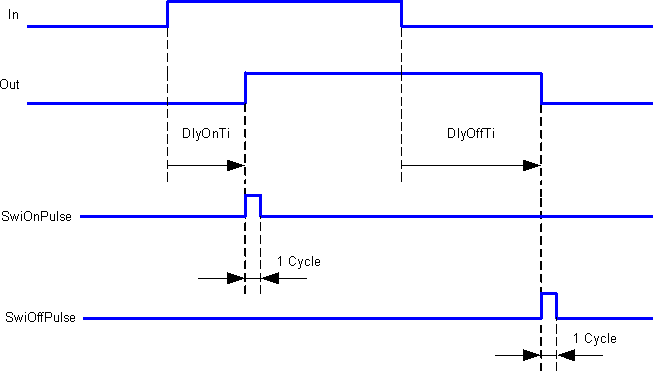
Minimum pulse length to switch on and off
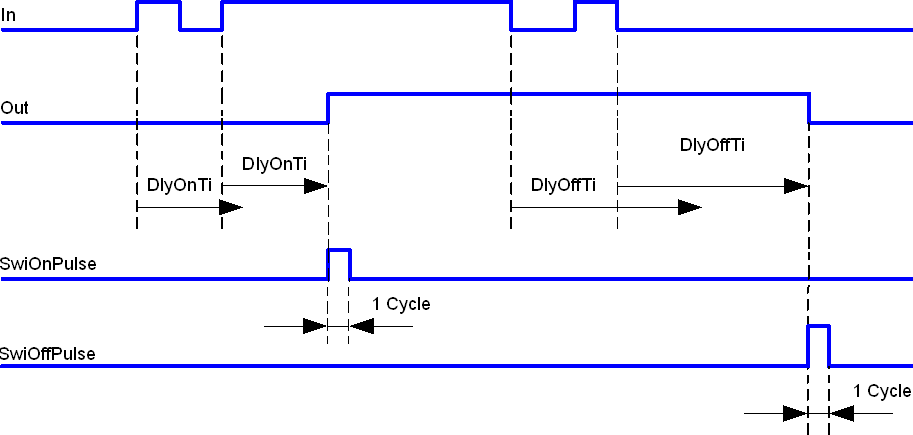
Cancel switch-on signal.
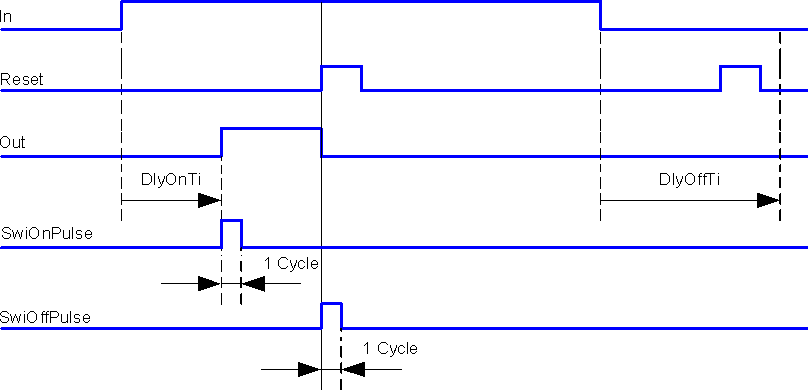
Cancel delay times.
Input | Description | Data type | Default value |
|---|---|---|---|
In | Input | Boolean | 0 |
DlyOn | Switch-on delay Waiting time until the stage is actually switched after the stage request is sent. | Time | 0 ms |
DlyOff | Switch-off delay Waiting time until the stage is actually switched off after the stage request reset is sent. | Time | 0 ms |
Reset | Reset | Boolean | 0 |
0 - Do not reset | |||
ResetTi | Reset times An input pulse resets all internal operating hours counters to 0. External operating hours counters are not affected. | Boolean | 0 |
0 - No | |||
Output | Description | Data type | Default value |
|---|---|---|---|
Out | Output | Boolean | 0 |
PlsSwiOn | Switch-on pulse | Boolean | 0 |
0 - No | |||
PlsSwiOff | Switch-off pulse | Boolean | 0 |
0 - No | |||
TiEld | Elapsed time The time expired to date is pending. After reaching [Ti], [TiEld] is reset to 0. | Time | 0 ms |
- If for Start [In] = 1 then [DlyOnTi] starts.
After expiration of [DlyOnTi], [Out] = 1 and [SwiOnPulse] is triggered. - For Start [In] = 0 then [Out] remains = 0.
[DlyOffTi] is not started and [SwiOffPulse] is not triggered.