Object multistate output (MO)
Object type multistate output (MO) includes the BACnet properties for one multistate output.
There is a dependency between 'Name', 'Description' and 'Naming extension'. Any changes to one impacts the other two properties.
Note:
The dependency can be eliminated by entering a project-specific text.
Example 1:
The preconfigured 'Description' "Supply air humidity" sets the 'Name' to "HuSu" if selected. If "Abs" is selected as a supplement to the 'Naming extension', the description is supplemented by "(Absolut)" to "Supply air humidity (absolute)" and the name becomes "HuSu(Abs)". The name also forms the last element of the object name.
Example 2:
The preconfigured 'Description' "Room temperature" sets the 'Name' to "TR" if selected. Selecting "01" (project-specific text) in addition to 'Naming extension', results in the 'Name' "TR(01)". The name also forms the last element of the object name.
Name |
|
|
|---|---|---|
'Name' is a name specific to the instance. It is used to set up a hierarchical object name. | ||
Property ID: 4438 | ||
Description |
|
|
|---|---|---|
'Description' describes a BACnet object. The 'Description' is a translatable string that is saved internally as a text reference or directly as a string. | ||
Property ID: 28 | ||
Name extension |
|
|
|---|---|---|
'Name extension' is an optional extension of the name. It uniquely identifies an object or to distinguish objects. | ||
Property ID: 4437 | ||
Note
Designations from the text catalog can also be used for the 'Naming extension'.
Alarming is implemented under the principle of intrinsic reporting within a BACnet object.
Select the "Properties" tab to add the extension, select 'Yes' in the "Enable event" field. The BACnet properties required for the setting are displayed in ABT Site and the Programming Editor under the "Properties" tab.
Alarming
Overview
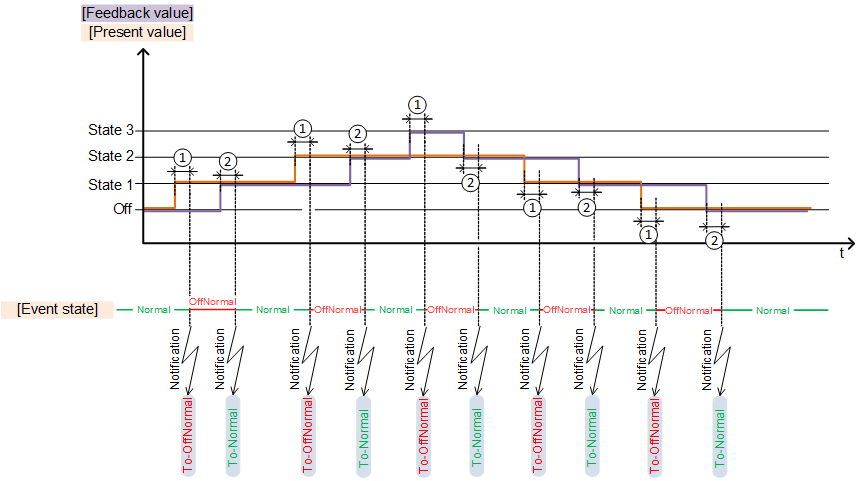
① 'Monitoring time deviation'
② 'Monitoring time deviation to normal'
Enable event |
|
|
|---|---|---|
'Enable event' enables the alarm function. The BACnet properties required to set the function are displayed. For setting 'Yes', the settings 'Extension with event configuration' is set to 'Intrinsic event registration'. | ||
Property ID: 35 | ||
Monitoring time deviation |
|
|
|---|---|---|
'Monitoring time deviation' determines the time in [s], during which the feedback cannot be equal to the present value before an event "To-OffNormal" is triggered. | ||
Property ID: 113 | ||
Monitoring time deviation to normal |
|
|
|---|---|---|
'Monitoring time deviation to normal' determines the time in [s], during which the feedback cannot be equal to the present value before an event "To-Normal" is triggered. | ||
Property ID: 356 | ||
Notification class |
|
|
|---|---|---|
'Notification class' determines the priority of an event and whether the event must be acknowledged or reset. The following are the notification classes: | ||
Property ID: 17 | ||
Enable event detection |
|
|
|---|---|---|
'Enable event detection' enables event detection. The "Event state" is always "Normal" with setting 'No'. | ||
Property ID: 353 | ||
Suppress event notification |
|
|
|---|---|---|
'Suppress event notification' determines whether event notifications are suppressed. | ||
Property ID: 4972 | ||
Suppress event detection |
|
|
|---|---|---|
'Suppress event detection' determines whether event detection is suppressed. | ||
Property ID: 354 | ||
Enable Trend |
|
|
|---|---|---|
'Enable trend' enables the trend function. A new BACnet object for type TRENDLOG is instantiated, automatically connected to property "Present value" of the selected object and the BACnet properties required for setting are shown in tab "Properties". | ||
Enable logging |
|
|
|---|---|---|
'Enable logging' enables trend logging. Logging of data points begins as of the start date and start time is reached. Trend logging stops if the stop date and stop time are reached or when the buffer is full (if set). Start date and start time (wildcards) are not defined by default. In other words, the setting 'Enable logging' = 'Yes' immediately starts trending. | ||
Property ID: 133 | ||
Logging Type |
|
|
|---|---|---|
'Logging Type' determines when a data point is trended. | ||
Property ID: 197 | ||
Logging interval |
|
|
|---|---|---|
'Logging interval' determines the interval (cycle) at which the value is logged. The setting takes effect by setting 'polled' for 'Logging Type'. | ||
Property ID: 134 | ||
Start time |
|
|
|---|---|---|
'Start time' determines the date and time to start trend logging. | ||
Property ID: 142 | ||
Stop time |
|
|
|---|---|---|
'Stop time' determines the date and time to end trending logging. | ||
Property ID: 143 | ||
Stop when full |
|
|
|---|---|---|
'Stop when full' determines whether to stop trend logging if the buffer is full. | ||
Property ID: 144 | ||
The setting 'Notification threshold' can determine when an event to retrieve data, e.g. by Desigo CC is triggered before the buffer becomes full.
Buffer size |
|
|
|---|---|---|
'Buffer size' determines the maximum number of values that can be saved to the buffer. The setting 'Stop if full' determines how to proceed if the buffer is full. Note The value for property 'Buffer size' must be greater than or equal to the value for property 'Notification threshold'. | ||
Property ID: 126 | ||
Align intervals |
|
|
|---|---|---|
'Align intervals' determines whether the periodic polling interval is aligned at the start of a specific second, minute, hour, or day. The setting has no effect for 'Logging Type' = 'COV'. This ensures that values from multiple, simultaneous trend logs can be saved at the same time and compared. Alignment is only possible for whole number multiples (1…x) of a second, minute, hour, or day. | ||
Property ID: 193 | ||
Interval offset |
|
|
|---|---|---|
'Interval offset', measured in hundredths of a second, permit cyclical trend logs to be spread out. With lots of active trend logs, this prevents a situation where all values are polled at the same time. Polling can be subdivided by staging in groups. 'Interval offset' is only active if the setting 'Align interval' = 'Yes'. | ||
Property ID: 195 | ||
Notification threshold |
|
|
|---|---|---|
'Notification threshold ' determine when the buffer sends a request to retrieve data. As soon as the set number of data entries is reached, an event notification is sent for the management station to retrieve the data. Data points are deleted from the buffer after retrieval. | ||
Property ID: 137 | ||
Present value |
|
|
|---|---|---|
'Present value' indicates the present value of the virtual variable. | ||
Property ID: 85 | ||
Tracking value |
|
|
|---|---|---|
'Tracking value' represents the uncorrected value as measured by the subsystem. It has the same data type as the 'Present value'.
| ||
Property ID: 5107 | ||
Default command |
|
|
|---|---|---|
'Default command' is the default value to be used for property 'Present value' if all priority values for commands have a value of zero in property 'Priority array'. | ||
Property ID: 104 | ||
Reliability |
|
|
|---|---|---|
'Reliability' indicates whether the property value 'Present value' is reliable. If the 'Present value' is not reliable, the property 'Reliability' indicates the cause of the fault and the bit "Fault" of the state indication is set to 'True'. In a normal case, the property 'Reliability' is set to "No fault". | ||
Property ID: 103 | ||
Suppress fault monitoring |
|
|
|---|---|---|
'Suppress fault monitoring' determines whether the fault supervision (fault events) is suppressed ('Yes'/'No'). The setting 'Yes' suppresses the evaluation of 'Reliability' and the value for 'Reliability' remains on "No fault". | ||
Property ID: 357 | ||
Number of states |
|
|
|---|---|---|
'Number of states' defines the number of states that can report 'Present value'. | ||
Property ID: 74 | ||
State text |
|
|
|---|---|---|
'State text' specifies the enumeration of the multistate value. Preconfigured enumerations can be selected or set to a project-specific enumeration. | ||
Property ID: 110 | ||
Signal type |
|
|
|---|---|---|
'Signal type' defines the signal type for its I/O channel. The available signal types depend on the specific hardware, e.g. I/O module type or Onboard-I/O type. | ||
Property ID: 4968 | ||
Select checkboxes to select preconfigured signals (e.g. Switch on/off, NO contact, 2 channels). The 'Number of states' is based on the selected signal type and mapping type.
Example ('Mapping type' "Mapping_1_n"):
Switch on/off, NO contact, 2 channels, number of states: 3, number of binary contacts: 2.
Note:
The preconfigured 'Number of states' can be adapted after the fact.
Number of channels |
|
|
|---|---|---|
'Number of channels' indicates the number of binary channels used to determine the multistate value. | ||
Property ID: 4981 | ||
Boost time ✳ |
|
|
|---|---|---|
'Boost time' sets the time in 1/10 [s] during which the motor operates at the highest stage at startup before switching back to the desired stage. Motors on some small fans with stages have too low a torque to operate the fan at the lowest stage. As a consequence, multistage fans can be started at the highest stage and only then switched back to the desired stage. | ||
Property ID: 4969 | ||
Mapping kind |
|
|
|---|---|---|
'Mapping kind' sets possible combinations of contacts for mapping to the states. | ||
Property ID: 4470 | ||
Mapping table |
|
|
|---|---|---|
"Mapping table" is the mapping of the combinations of the contacts to the states. | ||
Property ID: 4791 | ||
Note:
Changes in the 'Mapping type' has an impact on preconfigured settings in the 'Mapping table'.
Interaction between mapping type and mapping table
Select checkboxes to select the mapping types "Mapping_1_n", "MappingUpDown", and "MappingBinary".
Note:
The enumeration "Off", "Stage 1", "Stage 2" was selected for the following examples of interaction between the mapping type and the mapping table.
Mapping_1_n (default)
- Mapping_1_n is a defined 1:1 assignment of a contact to a state. Only one contact is active for each state (no contact is active for "Off").
The following applies for Mapping_1_n: Number of states = Number of channels + 1, since all channels are on 0 for state "Off". - Example:
- Signal: Switch on/off, NO contact, 2 channels, number of states: 3, number of binary contacts: 2.
- The number of 'States' is preset by 'Mapping type' "Mapping_1_n" and cannot be changed. We recommend a preconfigured 'Mapping table' that can be changed after the fact.
State | Active contacts |
|---|---|
Off | None |
Stage 1. | Contact 1 |
Stage 2 | Contact 2 |
MappingUpDown
- MappingUpDown is the assignment of multiple contacts to one state that always has one contact connected to it.
The following applies for MappingUpDown: Number of states = Number of channels + 1, since all channels are on 0 for state "Off". - Example:
- Signal: Switch on/off, NO contact, 2 channels, number of states: 3, number of binary contacts: 2.
- The number of 'States' is preset by 'Mapping type' "MappingUpDown" and cannot be changed. We recommend a preconfigured 'Mapping table' that can be changed after the fact.
State | Active contacts |
|---|---|
Off | None |
Stage 1. | Contact 1 |
Stage 2 | Contact 1 + Contact 2 |
MappingBinary
- MappingBinary is an assignment where states such as binary combinations are formed.
The following applies to MappingBinary: Number of states = Number of channels ≤ 2Number of channels. - Example:
- Signal: Switch on/off, NO contact, 2 channels, number of states: 3, number of binary contacts: 2.
- The number of 'States' is suggested by 'Mapping type' "MappingBinary" and cannot be changed. We recommend a preconfigured 'Mapping table' that can be changed after the fact.
For 'Number of states' = 3:
(0,0; 0,1; 1,0)
State | Active contacts |
|---|---|
Off | None |
Stage 1. | Contact 1 |
Stage 2 | Contact 2 |
For manual change to 'Number of states' to 4 (and modification to enumeration):
(0,0; 0,1; 1,0; 1,1)
State | Active contacts |
|---|---|
Off | None |
Stage 1. | Contact 1 |
Stage 2 | Contact 2 |
Stage 3. | Contact 1 + Contact 2 |
Min.switch-off time |
|
|
|---|---|---|
"Min.switch-off time" defines the minimum time that a device must be switched off during a switching cycle. Range: 1...30 [1 s] | ||
Property ID: 66 | ||
Pulse time |
|
|
|---|---|---|
'Pulse time' sets the pulse duration in 1/10 [s] for channels 2...n. The out pulse is exempted. | ||
Property ID: 4631 | ||
Data aggregation takes place with an extension (data aggregation) within a BACnet object. This includes the corresponding algorithm for data aggregation during a period. The aggregated value of the present period and last period are always displayed. Data aggregation permits operating hours counting as well as virtual metering, calculating key performance indicators and data analysis.
The extension is added with the following setting in tab "Properties":
- 'Enable aggregation' with setting 'Yes'
The setting 'Enable aggregation' = 'Yes', the extension is enabled and the required BACnet properties are displayed.

One BACnet object can have a maximum of one extension with data aggregation. A value that is aggregated to multiple types, requires multiple BACnet objects, each with a data aggregator that references the original object, e.g. one BACnet object for determining the 'Operating hours' and another for determining the 'Average value'.
Aggregation: Operating hours & others |
|
|
|---|---|---|
'Aggregation: Operating hours & others' permits data aggregation. | ||
Property ID: 4580 | ||
Select checkboxes for the following settings:
- 'None': No data aggregation takes place.
- 'Operating hours': No data aggregation takes place. The time is aggregated, while 'Active' applies as the 'Present value' (PrVal>1).
- 'Switch-on count': No data aggregation takes place. The number of switch-ons of the present value are counted.
Enable aggregation |
|
|
|---|---|---|
'Enable aggregation' enables or disables aggregation. | ||
Property ID: 4514 | ||
Aggregation period |
|
|
|---|---|---|
'Aggregation period' sets the duration of the aggregation period. Note | ||
Property ID: 4513 | ||
Multistate operating hours
The multistate operating hours permits data aggregation to determine the runtime of the present value.
The properties are divided into 2 groups:
- Operating hours count and maintenance indication A
- Statistical evaluation (data analysis) B
A: Operating hours count and maintenance indication
Note
The time is measured as active time during which the 'Present value' was active (PrVal>1).
Elapsed active time present period |
|
|
|---|---|---|
'Elapsed active time present period' is the expired time in [s] in the present period during which the 'Present value' was considered 'active' (PrVal>1). | ||
Property ID: 4512 | ||
Elapsed active time previous period |
|
|
|---|---|---|
'Elapsed active time previous period' is the expired time in [s] in the previous period during which the 'Present value' was considered 'active' (PrVal>1). | ||
Property ID: 4511 | ||
Operating hours |
|
|
|---|---|---|
'Operating hours' represents the aggregated number in [s] during which the property 'Present value' was 'active' (since the property 'Operating hours' was last reset). 'Operating hours' is synonymous with the expired active time. | ||
Property ID: 33 (Standard BACnet property, used for binary objects only) Property ID: 4490 (Proprietary BACnet property, used for analog and multistate objects) | ||
Elapsed active time limit present period |
|
|
|---|---|---|
'Elapsed active time limit present period' sets the time limit for the present period in [s] for the 'Expired active time present period' after which the 'Maintenance indication' is enabled. | ||
Property ID: 4509 | ||
Elapsed active time limit |
|
|
|---|---|---|
'Elapsed active time limit' sets the time limit in [s] for 'Operating hours' after which the 'Maintenance indication' is enabled. | ||
Property ID: 4510 | ||
Maintenance indication |
|
|
|---|---|---|
'Maintenance indication' supplies a maintenance note. The following maintenance notes can be indicated: 'Normal mode', 'Present period limit exceeded', 'Time limit exceeded'. | ||
B. Statistical evaluation (data analysis)
Elapsed active time per state present period |
|
|
|---|---|---|
'Elapsed active time per state present period' is the expired time in [s] in the present period during which the 'Present value' was in the applicable state. It is an array with the dimension = Number of states and includes one entry per partial range. | ||
Property ID: 4484 | ||
Elapsed active time per state previous period |
|
|
|---|---|---|
'Elapsed active time per state previous period' is the expired time in [s] in the previous period during which the 'Present value' was in the applicable state. It is an array with the dimension = Number of states and includes one entry per partial range. | ||
Property ID: 4483 | ||
Elapsed active time per state |
|
|
|---|---|---|
'Elapsed active time per state' is the expired time in [s] during which the 'Present value' was in the applicable state since the 'Expired active time' was last set to zero. It is an array with the dimension = Number of states and includes one entry per partial range. | ||
Property ID: 4485 | ||
Multistate switch-on count
The multistate switch-on count permits data aggregation to determine the number of switch-ons of the present value.
The properties are divided into 2 groups:
- Switch-on count and maintenance indication A
- Statistical evaluation (data analysis) B
A: Switch-on count and maintenance indication
Switch-on count present period |
|
|
|---|---|---|
'Switch-on count present period' indicates the number of switch-ons of 'Present value' from the present period. | ||
Property ID: 4508 | ||
Switch-on count previous period |
|
|
|---|---|---|
'Switch-on count previous period' indicates the number of switch-ons of 'Present value' from the previous period. | ||
Property ID: 4507 | ||
Switch-on count |
|
|
|---|---|---|
'Switch-on count' indicates the number of switch-ons of 'Present value' since the switch-on count was reset. | ||
Property ID: 4506 | ||
Time of switch-on count reset |
|
|
|---|---|---|
'Time of switch-on count reset' indicates the date and time of the last reset. | ||
Property ID: 4505 | ||
Switch-on count limit present period |
|
|
|---|---|---|
'Switch-on count limit present period' sets the number of switchings after which the 'Maintenance indication' is enabled. | ||
Property ID: 4503 | ||
Switch-on count limit |
|
|
|---|---|---|
'Switch-on count limit' sets the number of switchings after which the 'Maintenance indication' is enabled. | ||
Property ID: 4504 | ||
Maintenance indication |
|
|
|---|---|---|
'Maintenance indication' supplies a maintenance note. The following maintenance notes can be indicated: 'Normal mode', 'Present period limit exceeded', 'Time limit exceeded'. | ||
B. Statistical evaluation (data analysis)
Switch-on count per state present period |
|
|
|---|---|---|
'Switch-on count per state present period' indicates the number of switch-ons of 'Present value' from the present period in the applicable state. It is an array with the dimension = Number of states and includes one entry per partial range. | ||
Property ID: 4479 | ||
Switch-on count per state previous period |
|
|
|---|---|---|
'Switch-on count per state previous period' indicates the number of switch-ons of 'Present value' from the previous period in the applicable state. It is an array with the dimension = Number of states and includes one entry per partial range. | ||
Property ID: 4478 | ||
Switch-on count per state |
|
|
|---|---|---|
'Switch-on count per state' indicates the number of switch-ons of 'Present value' in the applicable period. It is an array with the dimension = Number of states and includes one entry per partial range. | ||
Property ID: 4477 | ||