Multistate simple process value object (MSmpPrcVal)
Object type Multistate Simple Process Value (MSmpPrcVal) includes the BACnet properties for one multistate simple process value.
Naming
There is a dependency between 'Name', 'Description' and 'Naming extension'. Any changes to one impacts the other two properties.
Note:
The dependency can be eliminated by entering a project-specific text.
Example 1:
The preconfigured 'Description' "Controller state" sets the 'Name' to "CtrSta" if selected. If "Abs" is selected as a supplement to the 'Naming extension', the description is supplemented by "(Absolute)" to "Controller state (absolute)" and the name becomes "CtrSta(Abs)". The name also forms the last element of the object name.
Name |
|
|
|---|---|---|
'Name' is a name specific to the instance. It is used to set up a hierarchical object name. | ||
Property ID: 4438 | ||
Description |
|
|
|---|---|---|
'Description' describes a BACnet object. The 'Description' is a translatable string that is saved internally as a text reference or directly as a string. | ||
Property ID: 28 | ||
Name extension |
|
|
|---|---|---|
'Name extension' is an optional extension of the name. It uniquely identifies an object or to distinguish objects. | ||
Property ID: 4437 | ||
Note
Designations from the text catalog can also be used for the 'Naming extension'.
Alarming is implemented under the principle of intrinsic reporting within a BACnet object.
Select the "Properties" tab to add the extension, select 'Yes' in the "Enable event" field. The BACnet properties required for the setting are displayed in ABT Site and the Programming Editor under the "Properties" tab.
Alarming
Overview
Values on a multistate object can be interpreted as alarm values (OffNormal alarm) or fault values (Fault alarm). This is helpful on integrations where a single multistate value represents a lot of states on the device for integration.
Only the alarm value is used on most applications.
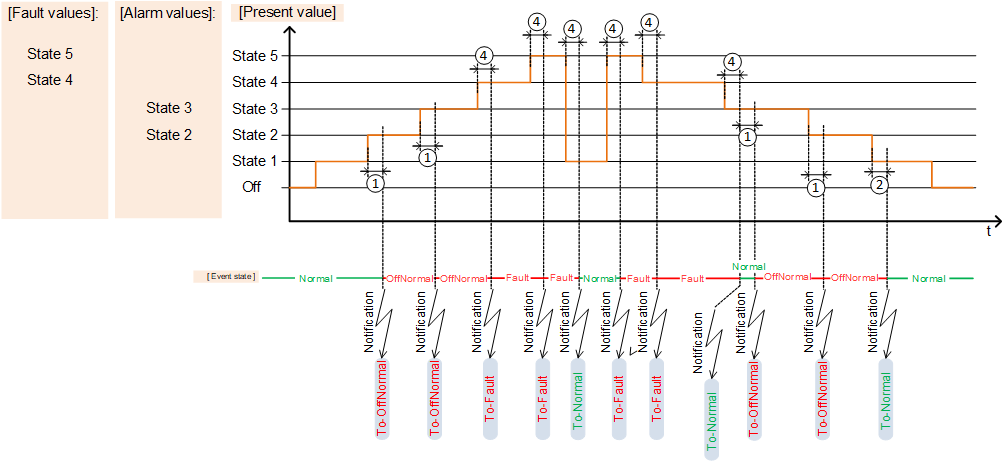
① 'Monitoring time deviation'
② 'Monitoring time deviation to normal'
③ 'Hysteresis to normal'
Enable event |
|
|
|---|---|---|
'Enable event' enables the alarm function. The BACnet properties required to set the function are displayed. For setting 'Yes', the settings 'Extension with event configuration' is set to 'Intrinsic event registration'. | ||
Property ID: 35 | ||
Alarm values |
|
|
|---|---|---|
'Alarm values' determines whether an alarm "To-OffNormal" is triggered when a MI changes state. | ||
Property ID: 7 | ||
Select check boxes for MI states that trigger an alarm.
All check boxes cleared: Inactive
State 1: For a change to MI state 1, an alarm is triggered and a message "To-OffNormal" is sent. The object becomes "OffNormal".
…
State 6: For a change to MI state 6, an alarm is triggered and a message "To-OffNormal" is sent. The object state becomes "OffNormal".
Fault values |
|
|
|---|---|---|
'Fault values' determines whether a fault "To-Fault" is reported when a MI changes state. | ||
Property ID: 39 | ||
Select check boxes for MI states that trigger a fault.
All check boxes cleared: Inactive
State 1: For a change to MI state 1, a fault is triggered and a message "To-Fault" is sent. The object becomes "Fault".
…
State 6: For a change to MI state 6, a fault is triggered and a message "To-Fault" is sent. The object state becomes "Fault".
Monitoring time deviation |
|
|
|---|---|---|
'Monitoring time deviation' determines the time in [s], during which the present state is equal to a state defined for 'Alarm values' before an event "To-OffNormal" is triggered. The time is also considered for a change between alarm values. | ||
Property ID: 113 | ||
Monitoring time deviation to normal |
|
|
|---|---|---|
'Monitoring time deviation to normal' determines the time in [s], during which the present state must have a normal state when changing from "OffNormal" to "Normal" before an event "To-Normal" is triggered. | ||
Property ID: 356 | ||
Monitoring time deviation for reliability |
|
|
|---|---|---|
'Monitoring time deviation for reliability' determines the time in [s], during which the present state is equal to a state defined for 'Fault values' before an event "To-Fault" is triggered. The time is also considered when changing between fault values ("Fault"), changing to "OffNormal" and changing to "Normal". Upon returning from "Fault" to "OffNormal", the object initially returns to "Normal" after this time expires and only changes to "OffNormal" after the additional expiration of "Monitoring time deviation". | ||
Property ID: 4974 | ||
Notification class |
|
|
|---|---|---|
'Notification class' determines the priority of an event and whether the event must be acknowledged or reset. The following are the notification classes: | ||
Property ID: 17 | ||
Enable event detection |
|
|
|---|---|---|
'Enable event detection' enables event detection. The "Event state" is always "Normal" with setting 'No'. | ||
Property ID: 353 | ||
Suppress event notification |
|
|
|---|---|---|
'Suppress event notification' determines whether event notifications are suppressed. | ||
Property ID: 4972 | ||
Suppress event detection |
|
|
|---|---|---|
'Suppress event detection' determines whether event detection is suppressed. | ||
Property ID: 354 | ||
Other
Default command |
|
|
|---|---|---|
'Default command' is the default value to be used for property 'Present value' if all priority values for commands have a value of zero in property 'Priority array'. | ||
Property ID: 104 | ||
Suppress fault monitoring |
|
|
|---|---|---|
'Suppress fault monitoring' determines whether the fault supervision (fault events) is suppressed ('Yes'/'No'). The setting 'Yes' suppresses the evaluation of 'Reliability' and the value for 'Reliability' remains on "No fault". | ||
Property ID: 357 | ||
Number of states |
|
|
|---|---|---|
'Number of states' defines the number of states that can report 'Present value'. | ||
Property ID: 74 | ||
State text |
|
|
|---|---|---|
'State text' specifies the enumeration of the multistate value. Preconfigured enumerations can be selected or set to a project-specific enumeration. | ||
Property ID: 110 | ||
Startup mode |
|
|
|---|---|---|
'Startup mode' defines the startup behavior of the BA-Simple-Process-Value-Object to initialize 'Present value' and Update count. | ||
Property ID: 4349 | ||
Startup default |
|
|
|---|---|---|
'Startup default' defines the default value to be used for the 'Present value' after startup. | ||
Property ID: 4354 | ||
Present value |
|
|
|---|---|---|
'Present value' indicates the present value of the virtual variable. | ||
Property ID: 85 | ||
Data aggregation takes place with an extension (data aggregation) within a BACnet object. This includes the corresponding algorithm for data aggregation during a period. The aggregated value of the present period and last period are always displayed. Data aggregation permits operating hours counting as well as virtual metering, calculating key performance indicators and data analysis.
The extension is added with the following setting in tab "Properties":
- 'Enable aggregation' with setting 'Yes'
The setting 'Enable aggregation' = 'Yes', the extension is enabled and the required BACnet properties are displayed.

One BACnet object can have a maximum of one extension with data aggregation. A value that is aggregated to multiple types, requires multiple BACnet objects, each with a data aggregator that references the original object, e.g. one BACnet object for determining the 'Operating hours' and another for determining the 'Average value'.
Aggregation: Operating hours & others |
|
|
|---|---|---|
'Aggregation: Operating hours & others' permits data aggregation. | ||
Property ID: 4580 | ||
Select checkboxes for the following settings:
- 'None': No data aggregation takes place.
- 'Operating hours': No data aggregation takes place. The time is aggregated, while 'Active' applies as the 'Present value' (PrVal>1).
- 'Switch-on count': No data aggregation takes place. The number of switch-ons of the present value are counted.
Enable aggregation |
|
|
|---|---|---|
'Enable aggregation' enables or disables aggregation. | ||
Property ID: 4514 | ||
Aggregation period |
|
|
|---|---|---|
'Aggregation period' sets the duration of the aggregation period. Note | ||
Property ID: 4513 | ||
Multistate operating hours
The multistate operating hours permits data aggregation to determine the runtime of the present value.
The properties are divided into 2 groups:
- Operating hours count and maintenance indication A
- Statistical evaluation (data analysis) B
A: Operating hours count and maintenance indication
Note
The time is measured as active time during which the 'Present value' was active (PrVal>1).
Elapsed active time present period |
|
|
|---|---|---|
'Elapsed active time present period' is the expired time in [s] in the present period during which the 'Present value' was considered 'active' (PrVal>1). | ||
Property ID: 4512 | ||
Elapsed active time previous period |
|
|
|---|---|---|
'Elapsed active time previous period' is the expired time in [s] in the previous period during which the 'Present value' was considered 'active' (PrVal>1). | ||
Property ID: 4511 | ||
Operating hours |
|
|
|---|---|---|
'Operating hours' represents the aggregated number in [s] during which the property 'Present value' was 'active' (since the property 'Operating hours' was last reset). 'Operating hours' is synonymous with the expired active time. | ||
Property ID: 33 (Standard BACnet property, used for binary objects only) Property ID: 4490 (Proprietary BACnet property, used for analog and multistate objects) | ||
Elapsed active time limit present period |
|
|
|---|---|---|
'Elapsed active time limit present period' sets the time limit for the present period in [s] for the 'Expired active time present period' after which the 'Maintenance indication' is enabled. | ||
Property ID: 4509 | ||
Elapsed active time limit |
|
|
|---|---|---|
'Elapsed active time limit' sets the time limit in [s] for 'Operating hours' after which the 'Maintenance indication' is enabled. | ||
Property ID: 4510 | ||
Maintenance indication |
|
|
|---|---|---|
'Maintenance indication' supplies a maintenance note. The following maintenance notes can be indicated: 'Normal mode', 'Present period limit exceeded', 'Time limit exceeded'. | ||
B. Statistical evaluation (data analysis)
Elapsed active time per state present period |
|
|
|---|---|---|
'Elapsed active time per state present period' is the expired time in [s] in the present period during which the 'Present value' was in the applicable state. It is an array with the dimension = Number of states and includes one entry per partial range. | ||
Property ID: 4484 | ||
Elapsed active time per state previous period |
|
|
|---|---|---|
'Elapsed active time per state previous period' is the expired time in [s] in the previous period during which the 'Present value' was in the applicable state. It is an array with the dimension = Number of states and includes one entry per partial range. | ||
Property ID: 4483 | ||
Elapsed active time per state |
|
|
|---|---|---|
'Elapsed active time per state' is the expired time in [s] during which the 'Present value' was in the applicable state since the 'Expired active time' was last set to zero. It is an array with the dimension = Number of states and includes one entry per partial range. | ||
Property ID: 4485 | ||
Multistate switch-on count
The multistate switch-on count permits data aggregation to determine the number of switch-ons of the present value.
The properties are divided into 2 groups:
- Switch-on count and maintenance indication A
- Statistical evaluation (data analysis) B
A: Switch-on count and maintenance indication
Switch-on count present period |
|
|
|---|---|---|
'Switch-on count present period' indicates the number of switch-ons of 'Present value' from the present period. | ||
Property ID: 4508 | ||
Switch-on count previous period |
|
|
|---|---|---|
'Switch-on count previous period' indicates the number of switch-ons of 'Present value' from the previous period. | ||
Property ID: 4507 | ||
Switch-on count |
|
|
|---|---|---|
'Switch-on count' indicates the number of switch-ons of 'Present value' since the switch-on count was reset. | ||
Property ID: 4506 | ||
Time of switch-on count reset |
|
|
|---|---|---|
'Time of switch-on count reset' indicates the date and time of the last reset. | ||
Property ID: 4505 | ||
Switch-on count limit present period |
|
|
|---|---|---|
'Switch-on count limit present period' sets the number of switchings after which the 'Maintenance indication' is enabled. | ||
Property ID: 4503 | ||
Switch-on count limit |
|
|
|---|---|---|
'Switch-on count limit' sets the number of switchings after which the 'Maintenance indication' is enabled. | ||
Property ID: 4504 | ||
Maintenance indication |
|
|
|---|---|---|
'Maintenance indication' supplies a maintenance note. The following maintenance notes can be indicated: 'Normal mode', 'Present period limit exceeded', 'Time limit exceeded'. | ||
B. Statistical evaluation (data analysis)
Switch-on count per state present period |
|
|
|---|---|---|
'Switch-on count per state present period' indicates the number of switch-ons of 'Present value' from the present period in the applicable state. It is an array with the dimension = Number of states and includes one entry per partial range. | ||
Property ID: 4479 | ||
Switch-on count per state previous period |
|
|
|---|---|---|
'Switch-on count per state previous period' indicates the number of switch-ons of 'Present value' from the previous period in the applicable state. It is an array with the dimension = Number of states and includes one entry per partial range. | ||
Property ID: 4478 | ||
Switch-on count per state |
|
|
|---|---|---|
'Switch-on count per state' indicates the number of switch-ons of 'Present value' in the applicable period. It is an array with the dimension = Number of states and includes one entry per partial range. | ||
Property ID: 4477 | ||