Events
Event types
Event type is a read-only property which indicates the event algorithm to be used by an event enrollment object instance. The value of this property is determined by the selected alarm extension. There are different types of event enrollment (Event-Type) objects:
Default event type | Referenced BA object type |
|---|---|
Floating limit | Loop |
Command failure | Binary output, Multistate output |
Out of range | Analog input, Analog output, Analog value, Analog calculated value, Analog process value |
Unsigned range | Accumulator |
Change of state | Binary input, Binary value, Binary calculated value, Binary process value, Multistate input, Multistate value, Multistate calculated value, Multistate process value, Fieldbus management, Field device |
Change of bitstring | Other |
Floating limit
The floating limit event algorithm consists of parameters from the setpoint reference values for low limit and high limit. This is applicable for analog output values.
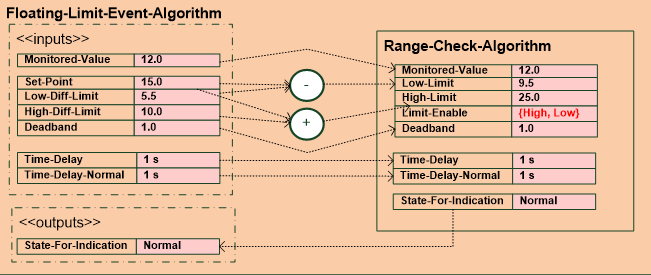
Floating limit parameters:
The setpoint reference provides the object reference for the setpoint and generates an alarm when its values are reached. The high limit and low limit alarm values set the maximum and minimum alarm limit values, the time delay specifies the duration for which an object must be in or out of alarm or fault for a notification to be sent.
Command failure
The command failure event algorithm compares the monitored value with a feedback reference value.
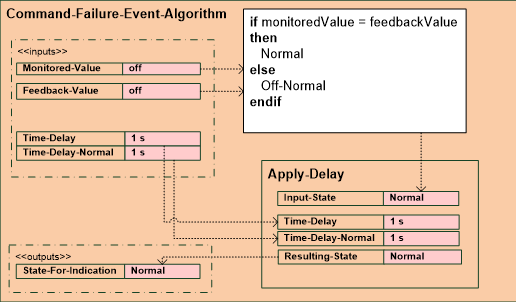
When the monitored value differs from the feedback value, an alarm is sounded. The feedback reference values are applicable only to binary output objects.
Out of range and unsigned range
The out of range and unsigned range event algorithms have high and low limits which are applied independently. The resulting state is combined in one state for indication.
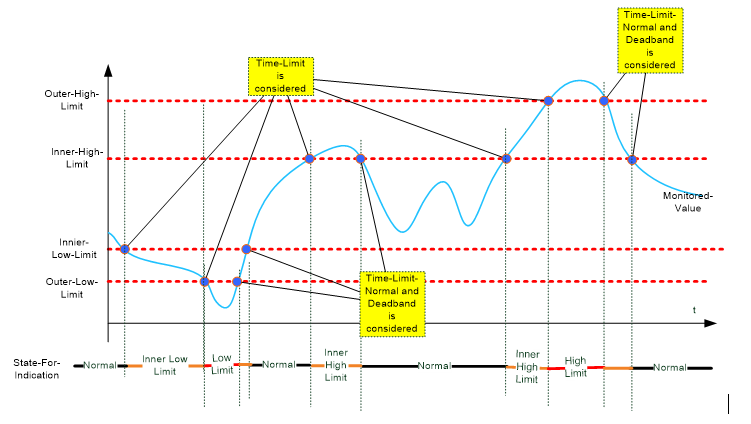
Out of range and unsigned range parameters:
The high limit and low limit alarm values set the maximum and minimum alarm limit values, the time delay specifies the duration for which an object must be in or out of alarm or fault for a notification to be sent.
Change of state
In the change of state event algorithm, a set of alarm values is defined. When the monitored value reaches one of these alarm values, it results in an offnormal state and an alarm is sounded.
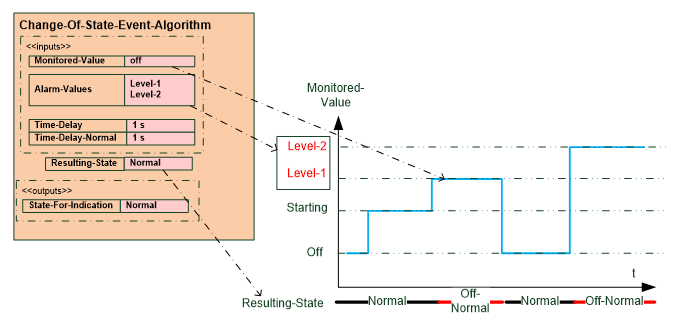
Change of state parameters:
The alarm values are a list of discrete values that are offnormal. When the monitored value reaches one of these values, an alarm is sounded. The high limit and low limit alarm values set the maximum and minimum alarm limit values. The time delay specifies the duration for which an object must be in or out of alarm or fault for a notification to be sent.
Change of bitstring
The change of bitstring event algorithm detects whether the monitored value of type bitstring equals a value that is listed as an alarm value, after applying a bitmask:
- If event state is normal, and test value, after applying bitmask, remains equal to any of the values contained in alarm values for the time period specified by time delay, then indicate a transition to the off-normal event state.
- If event state is offnormal, and test value, after applying bitmask, remains not equal to any of the values contained in alarm values for the time period specified by time delay normal, then indicate a transition to the normal event state
- If event state is offnormal, and test-value, after applying bitmask, is equal to one of the values contained in alarm values that is different from the value that caused the last transition to offnormal and remains equal to that value for the time period specified by time delay, then indicate a transition to the offnormal event state.
Change of bitstring parameters:
The bitstring parameters represent the bitmask that defines the bits of the monitored value that are significant for comparison with the alarm values. The alarm values are a list of discrete values that are offnormal. When the monitored value reaches one of these values, an alarm is sounded. The time delay specifies the duration for which an object must be in or out of alarm or fault for a notification to be sent.
Event notification
An event enrollment object also monitors the status flag property of an object with a referenced property. If the fault flag of the referenced object is set, an alarm is sounded.