[SP_FIELD] Determination of room setpoints via setpoint field
Function block SP_FIELD calculates the upper and lower temperature and humidity setpoints for sequence cascade control in dependence of the room air state and of the room setpoints (setpoint field).
SP_FIELD calculates the upper and lower temperature and humidity setpoints for sequence cascade control in dependence of the room air state and of the room setpoints (setpoint field). SP_FIELD allows users to easily parameterize room setpoints, which include temperature comfort in a room (setpoint field). Humidity and temperature setpoints are defined in a physical unit [% rel. humidity] in the function block and are transmitted as absolute humidity for the humidity control loop.
The following functions are integrated in the function block:
- Conversion of relative humidity values into absolute humidity values.
- The limits for the setpoint field can be set.
- Summer/winter compensation is possible.
The function block calculates the variable setpoints for sequence cascade control from the present room air state in accordance with the parameterized limit values (setpoint field). The parameterized relative humidity limit values are then converted to absolute humidity values.
Step | Process procedure in the function block |
|---|---|
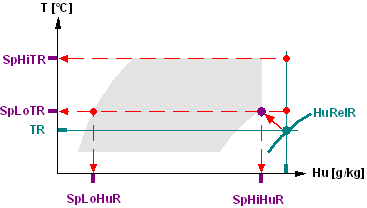
1 | The function block calculates the absolute humidity setpoints from the present room temperature [TR] and the setpoint field. The humidification setpoint [SpLoHuR] and dehumidification setpoint [SpHiHuR] is increased together with an increasing room temperature along the setpoint field. |
2 | The function block calculates the temperature setpoints from the current room humidity [HuRelR] and the setpoint field. With high humidity: |
--- | If summer/winter compensation is enabled [SwCmp] = 1, the heating setpoint [SpRH] and the cooling setpoint [SpRC] are corrected by the values [DSpH] and [DSpC]: |
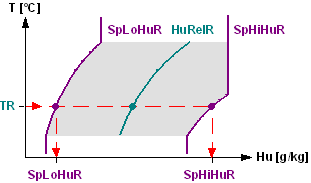
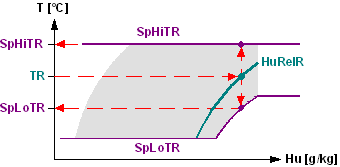
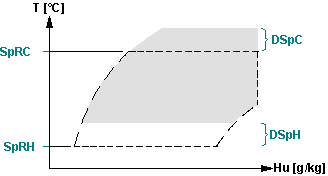
Example: Energy-free zone
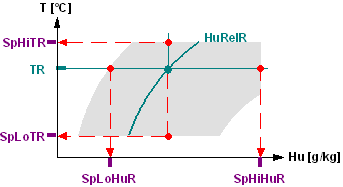
Example: Cooling/humidifying
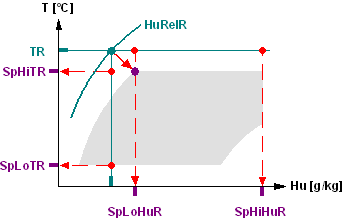
Example: Heating/dehumidifying
Input | Description | Data type | Default value |
|---|---|---|---|
TR | Room temperature Measures the (reference) room temperature. | Real | 20.0 [°C] 0.0…50.0 [°C] |
HuRelR | Relative humidity for room Measured value for the room humidity. | Real | 30.0 [%RH] 0.0...100.0 [%RH] |
SpRC | Room setpoint for cooling Cooling setpoint for room temperature. Upper limitation of the setpoint field. | Real | 26 [°C] 0.0...50.0 [°C] |
SpRH | Room setpoint for heating Heating setpoint for room temperature. Lower limitation of the setpoint field. | Real | 22 [°C] 0.0...50.0 [°C] |
SpRHu | Room setpoint for humidification | Real | 30.0 [%RH] 0.0...100.0 [%RH] |
SpRDhu | Room setpoint for dehumidification Dehumidification setpoint for room humidity (% relative humidity). Right limitation curve of the setpoint field. | Real | 60.0 [%RH] 0.0...100.0 [%RH] |
SpRHuAbs | Room setpoint for absolute humidity (limitation) Upper absolute setpoint for room humidity (g/kg absolute humidity). Right limitation of the setpoint field. If out of range, 20.0 is used. | Real | 11.0 [g/kg] 0.0...20.0[g/kg] |
AP | Air pressure Measured value for air pressure or constant value (see Engineering) | Real | 0.96 [bar] 0.0...4.0 [bar] |
SwCmp | Summer/winter compensation Enable/disable the correction of the heating and cooling setpoint. | Boolean | 0 |
0: No summer/winter compensation. | |||
DSpC | Delta cooling setpoint Delta of the cooling setpoint [SpRC] | Real | 0.0 [K] -20.0...20.0 [K] |
DSpH | Delta heating setpoint Delta of the heating setpoint [SpRH] | Real | 0.0 [K] -20.0...20.0 [K] |
Output | Description | Data type | Default value |
|---|---|---|---|
SpHiTR | Setpoint high: Room temperature Calculated cooling setpoint to control the room temperature. | Real | 26.0 [°C] |
SpLoTR | Setpoint low: Room temperature Calculated heating setpoint to control the room temperature | Real | 22.0 [°C] |
SpHiHuR | Setpoint high: Room humidity Calculated humidification setpoint (g/kg absolute humidity) to control the room humidity | Real | 5 [g/kg] |
SpLoHuR | Setpoint low: Room humidity Calculated dehumidification setpoint (g/kg absolute humidity) to control the room humidity. | Real | 10 [g/kg] |
|
SysUnits | System of units Indicates the system of units used by the block. | Integer | 1: International system of units (SI) (fallback) 1...5 |
1: International system of units (SI) (fallback) | |||
ErrCode | Error code indication | Integer | 0: No error |
= 0 - No error | |||
Parameterizing the setpoint field
The humidity setpoints [SpRHu] and [SpRDHu] are parameterized in % of relative humidity.
The absolute setpoint for humidity [SpRHuAbs] is parameterized in g/kg of absolute humidity.
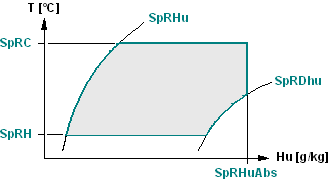
The limit values for the setpoint field are preset according to DIN 1946.
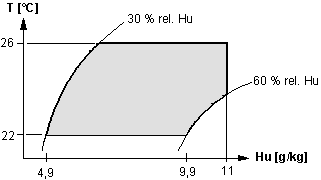
Basic design
SP_FIELD typically serves as a setpoint transmitter for sequence cascade control. SP_FIELD supplies the setpoints [SpHiTR], [SpLoTR] to temperature control, and the setpoints [SpHiHuR], [SpLoHuR] to humidity control.
Summer/winter compensation
The room setpoints for heating [SpRH] and cooling [SpRC] can be changed via pins [DSpH] and [DSpC], e.g., by interconnecting to an outside temperature-controlled setpoint compensation (characteristic curve of CHAR) or to a room unit.
Example: Outside temperature-controlled summer compensation
CHAR (CONTROL) supplies an outside temperature-controlled correction value for cooling based on the following sample points:
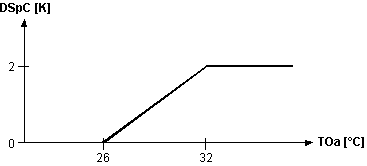
Outside temperature °C | 26 | 29 | 32 |
Correction value K | 0 | 1 | 2 |
The set cooling setpoint [SpRC] is corrected by factor [DSpC] in dependence of the outside air temperature TOa. Thus, the effective cooling setpoint is corrected to 27 °C for a cooling setpoint [SpRC] of e.g. 25 °C at an outside air temperature of 32 °C.
Example: Outside temperature-controlled winter compensation
CHAR (CONTROL) supplies an outside temperature-controlled correction value for heating based on the following sample points:
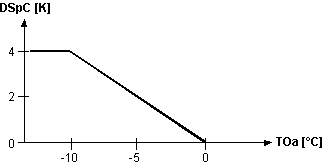
Outside temperature °C | -10 | 0 |
Correction value K | 4 | 0 |
The set heating setpoint [SpRH] is corrected by factor [DSpH] in dependence of the outside air temperature TOa. Thus, the effective heating setpoint is corrected to 24 °C for a heating setpoint [SpRH] of e.g. 20 °C at an outside air temperature of -10 °C.
Parameterizing air pressure [AP]
The air pressure influences the conversion of relative humidity to absolute humidity. If the air pressure is not available as a measured variable, it can be defined as a constant.
Air pressure decreases at increasing altitude above sea level; the constant thus needs to be defined in dependence of the altitude above sea level:
Altitude (m) | AP (bar) | Altitude (m) | AP (bar) |
|---|---|---|---|
0 | 1.013 | 1200 | 0.877 |
300 | 0.978 | 1500 | 0.846 |
600 | 0.943 | 1800 | 0.815 |
900 | 0.91 | 2100 | 0.785 |
Setpoint field
The function block allows the user to define the setpoints of the air conditioning plant according to a Comfort field. Humidity and temperature setpoints are defined in a physical unit [% rel. humidity] in a function block and are transmitted as absolute humidity for the humidity control loop.
SP_FIELD allows for parameterizing room setpoints, which include temperature comfort in a room (setpoint field). Thermic comfort exists when human beings are content with temperature and humidity of the surrounding environment. The range of the comfort room temperature and humidity is described in DIN 1946 Part 2 and is considered state-of-the-art technology.
There are two reasons why a field is used as a setpoint:
- Comfort sensation:
Optimal working environment conditions exist not just at a specific setpoint for room temperature and room humidity, but within a particular range. Additionally, it is meaningful to limit the absolute humidity at high temperatures; else, the air is too muggy. This limit value typically is 11 g/kg. - Energy savings:
The greater the setpoint field area, the greater the energy saving potential.
Summer/winter compensation
Today, summer/winter compensation represents a standard solution for ventilating and air conditioning plants. In this respect, the setpoint of the room temperature is shifted in dependence of the outside air temperature, e.g. with the characteristic curve of CHAR (CONTROL).
In summer operation, increasing the cooling setpoint prevents excessive temperature differences between the outside air temperature and the room temperature. Additionally, cooling energy is saved.
In winter operation, the influence of colder surrounding surfaces is balanced out by increasing the heating setpoint.
If the heating setpoint [SpRH] is greater than the cooling setpoint [SpRC], the cooling setpoint is corrected:
[SpRH] = [SpRC] - 0.5 K.
If the humidification setpoint [SpRHu] is greater than the dehumidification setpoints [SpRDhu], the dehumidification value is corrected:
[SpRHu] = [SpRDhu] - 5.0 %.
In these cases, the outputs are calculated according to the corrections.
The setpoint low: Room humidity [SpLoHuR] is also corrected if SpHiHuR - SpLoHuR is less than 0.5 g/kg.
SpLoHuR = SpHiHuR – 0.5 g/kg.