Central functions
Overview
The application type "Type central functions11" (CenFnct11) is a maximum software solution for superposed room automation functions.
The type includes commonly used AFs to centrally operate electrical and mechanical installations HVAC, lighting, and shading.
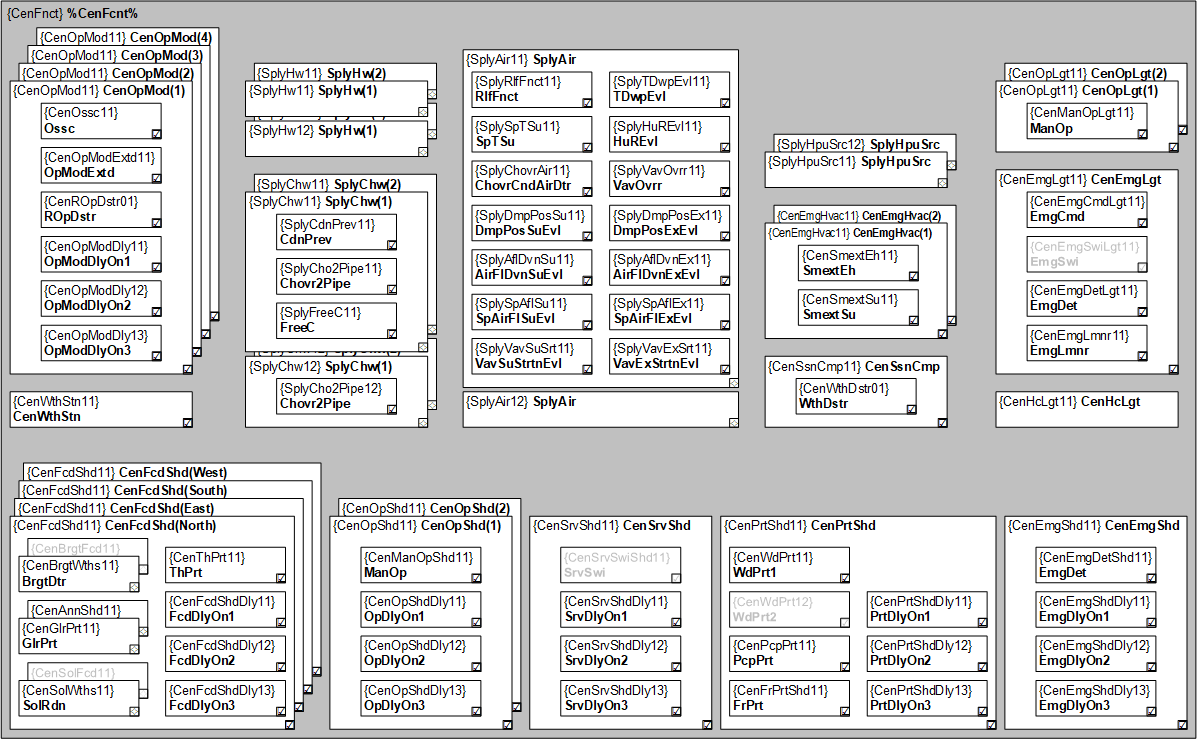
There may be multiple instances for certain AFs, e.g. central facade functions for the 4 cardinal points.
Function | HVAC | Lighting | Shading | Common | Supply |
|---|---|---|---|---|---|
Emergency | 2 | 1 | 1* |
|
|
Service |
|
| 1* |
|
|
Protection |
|
| 1* |
|
|
Manual operation |
| 2 | 2* |
|
|
Facade |
|
| 4* |
|
|
Seasonal compensation | 1 |
|
|
|
|
Control mode |
|
|
| 4* |
|
Weather station |
|
|
| 1 |
|
Air |
|
|
|
| 1 |
Cold water |
|
|
|
| 2 |
Hot water |
|
|
|
| 2 |
* There are staged delays for these AFs. In particular for shading actuators, the number of group members starting/operating simultaneously cannot be too large as this may otherwise overload the electric grid.
Distribution of information
Information from the following functions is distributed via grouping to the connected rooms.
- Central weather information
- Central operation
- Central service functions
- Central protection and emergency functions
- Functions for HVAC supply chains
Distribution can be organized hierarchically.
Hierarchical grouping
Collect and distribute information in supply chains
Information from the connected rooms are collected or distributed via grouping:
- Demand messages for supply chains (chilled water, hot water, air)
- State messages from supply chains
Collection and distribution can be organized (bundled) hierarchically.
Bundling supply AFs
Group categories
The following group categories are available:
- Occupancy
- Lighting
- Shading
- HVAC
- Facade
- Weather station
- Supply
They can be filtered on the management station.
Sub-categories
Depending on the function, communication is at a high priority to prevent unwanted local operation.
Priorities
Function | Priority |
|---|---|
Emergency function | Emg = Emergency, for example, fire or evacuation, the light is switched on and the blinds are opened. |
Service function | Srv = Service, for example, moving blinds to a defined position to clean windows. |
Protection function | Prt = Protection, for example, to close blinds at low outside temperatures or high solar radiation. |
Operation | Op = Operation, by scheduler, operator intervention via BACnet client or local operator unit. |
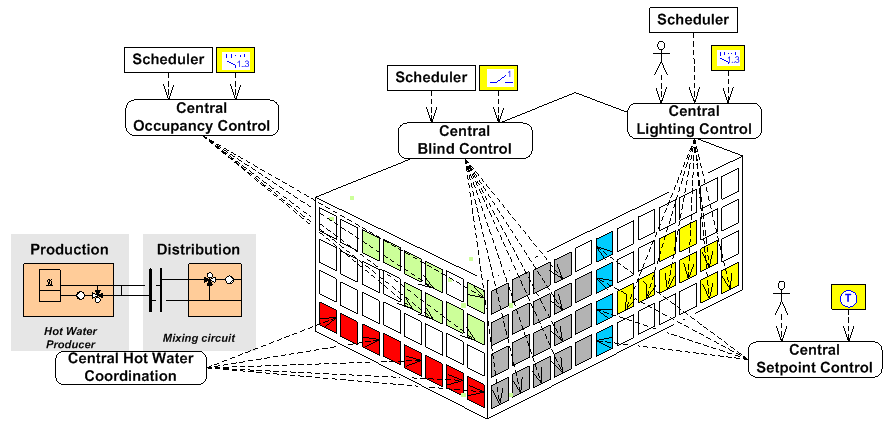
Central commands can originate from the following sources:
- External system or third-party device
- System user via BACnet client
- Building user via BACnet client or local operating element
- Scheduler or reaction program
- Superposed location based on grouping function.
Supply chains primary plants and room
Demand and forced signals from various consumers can be collected, evaluated and forwarded to the following components via grouping:
- SplyAir: To the primary air handling units
- SplyHw: To heating circuits
- SplyChw: To cooling circuits
Demand-controlled operation of primary plants is an important element for efficient energy use.
The supply changes are also used to protect plants, aggregates, or components (e.g. the air handling unit may not force air against closed dampers or VAV boxes).