Normal mode and exception mode
The plant always operates in one of the following operating modes:
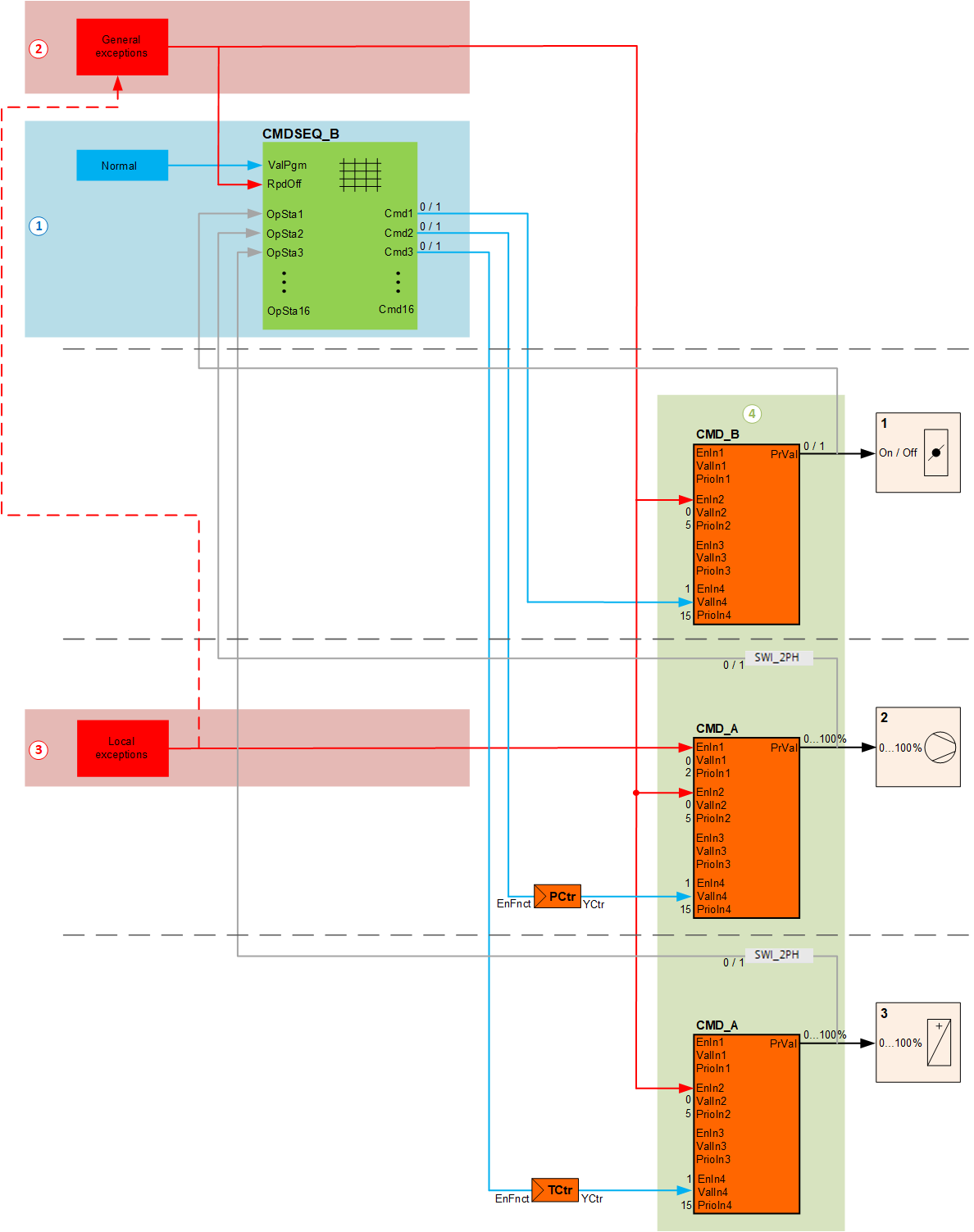
① Normal mode
② General exception mode
③ Local exception mode
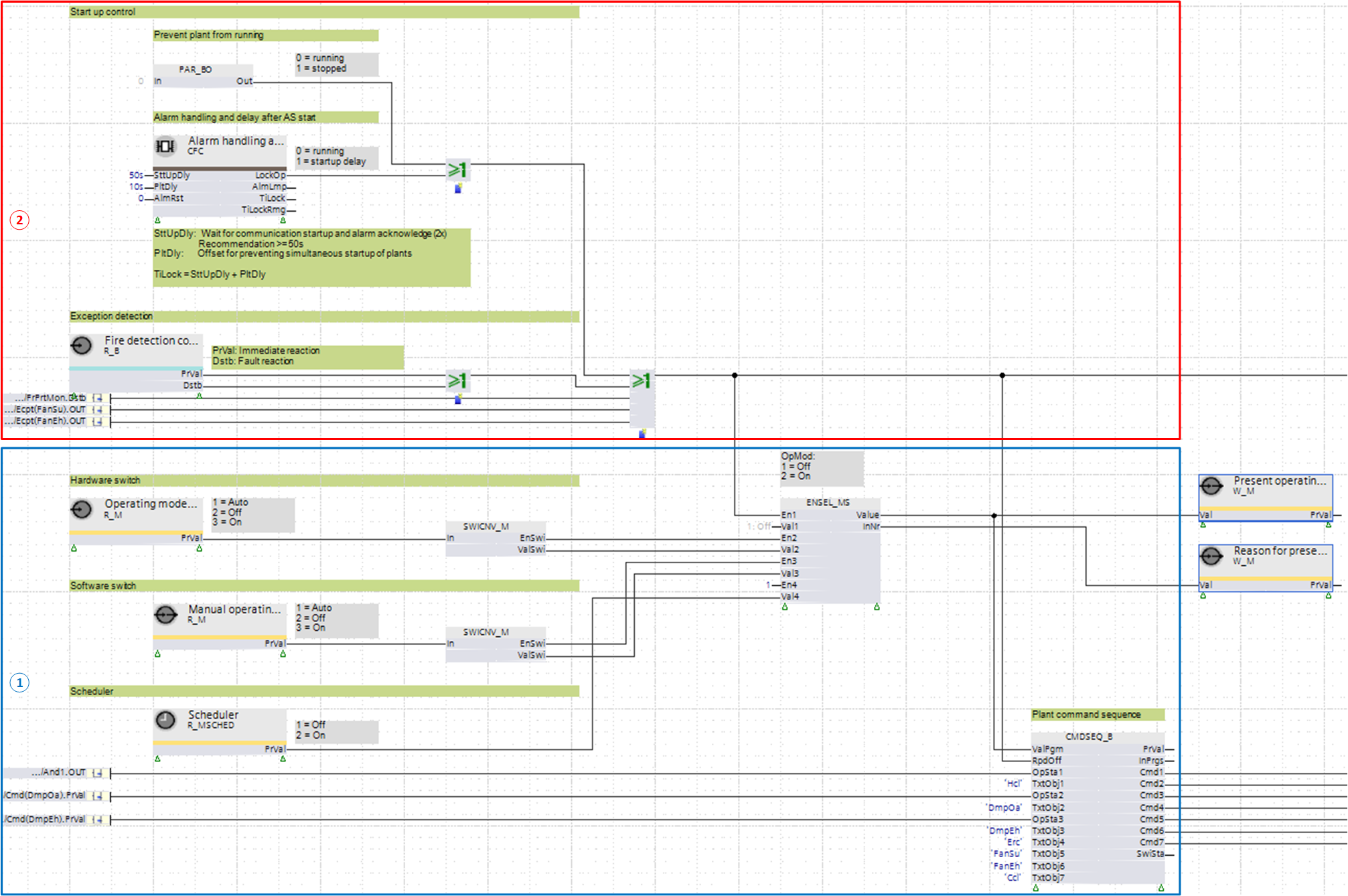
The chart strip for determining plant operating mode defines the input blocks and other function blocks that enable the various plant components.
The switch-on sequence and switch-off sequence of the output blocks can be defined via locking.
In normal mode, the various input blocks determine the present, normal plant operating mode 1...16.
The resulting plant operating mode 1...16 is transmitted to function block CMDSEQ_B.
The function block determines which plant components must be switched on based on this information as well as the switch-on and switch-off sequence.
The function block sends the corresponding switch-on and switch-off commands to the controller or output blocks of the plant components. The output blocks are typically operated at priority 15 = 'Automatic mode'.
As soon as the requested plant operating mode 1...16 changes on the input of function block CMDSEQ_B, the plant components are switched off as per the switch-off sequence and the newly required plant components are switched on as per the switch-on sequence.
In general exception mode, the present exception mode is determined under the input blocks.
Plant-external or plant-internal sources can trigger a general exception mode.
Plant-external sources may be:
- Fire safety contact
- Gas detection contact
- Smoke extraction control
Plant-internal sources may be:
- Fault message for a plant component, e.g., a fan
- Frost protection monitor
Normal mode is immediately ended via input [RpdOff] of function block CMDSEQ_B when exception mode is enabled.
The switch-on signals or typical switch-off signals are sent directly to the output blocks for the plant component. The output blocks are typically operated at priority 5 = 'Protection'.
As soon as the exception mode no longer applies, the normal mode is once again active and switches the plant components required for the present operating mode via CMDSEQ_B.
The local exception mode is used, if the exception mode takes priority on a neighboring area of the plant.
There are 2 types of local exception modes:
- Local only
- Acts locally with return to the general exception mode
Local only
Example: Energy recovery unit fault
The fault switches off the output block for the energy recovery unit via the local exception mode. The rest of the plant continues to operate in normal mode. The local exception mode does not return to the general exception mode.
Acts locally with return to the general exception mode
Example: Maintenance switch for the fan
Activating the maintenance switch switches off the output block for the fan at priority 2 (via the local exception mode).

A command at priority 1 can override the lock. This is desirable, for example, in order to perform a local data point test. The lock must be at priority 1 if there is no locking mechanism on the hardware side.