Locking for flat plants
Plant components must include a specific switch-on and switch-off sequence for the plant to operate in an optimum manner and prevent failures or damage. The plant components can be mutually locked to maintain the desired switch-on and switch-off sequence. The defined condition must be fulfilled on a plant component before the next plant component, linked via a locking mechanism, is enabled. A signal from output block CMD_A, CMD_B or CMD_M of the plant component is returned a release signal.
The locks can have a delay for delayed enable or delayed switch-off of a plant component.
Logical functions such as AND or OR can be integrated in a lock to render the enable dependent on additional signals.
There are two types of locks (see the examples below):
- Type 1
Returning an output signal from output block CMD_A, CMD_B or CMD_M to an input of function block CMDSEQ_B. - Type 2
Returning an output signal from output block CMD_A, CMD_B or CMD_M to an input on another output block CMD_A, CMD_B or CMD_M.
Overview of differences:
| Type 1: Via CMDSEQ_B | Type 2: Via output blocks |
|---|---|---|
|
Priority | Typically priority 15 (Automatic mode) | Priority can be selected on the input of the output block |
Timeframe for consideration | At plant switch on and switch off | Always |
Response in exception mode | Inactive | Active or inactive (based on the pin sequence on function block ENSEL) |
Both types of locks differ as follows:
- Priority
Type 1:Locking via CMDSEQ_B is typically determined on the applicable input of the output block at priority 15 (Automatic mode).
Typ 2: For locking between output blocks CMD_A, CMD_B or CMD_M, the priority on the applicable input for the output block is set (typically at priority 5). - Timeframe for consideration
Type 1: Locking via CMDSEQ_B is only considered when switching on and off the corresponding plant component. Once the locking signal is no longer available during operation, it has no influence on the operation of plant components.
Type 2: Locking between output blocks CMD_A, CMD_B or CMD_M is always active. They act at plant switch-on and switch-off as well as during operation. - Behavior in exception mode
Type 1: Locking via CMDSEQ_B has no effect. CMDSEQ_B and, with it, all connected plant components are switched off in exception mode. The output blocks are controlled directly by the exception mode.
Type 2: Locking between the output blocks CMD_A, CMD_B or CMD_M can be active or inactive in exception mode. This is determined by the pin sequence on function block ENSEL.
This type of lock can be selected if the switch-on and switch-off sequence is to be controlled, but no continuous monitoring of the plant component is required during operation, for example, on a ventilation plant with a hot water heating coil.
The signal of the active mode of the plant component is returned from output [PrVal] for output block CMD_A or CMD_B to the corresponding input [OpSta1]...[OpSta3]:
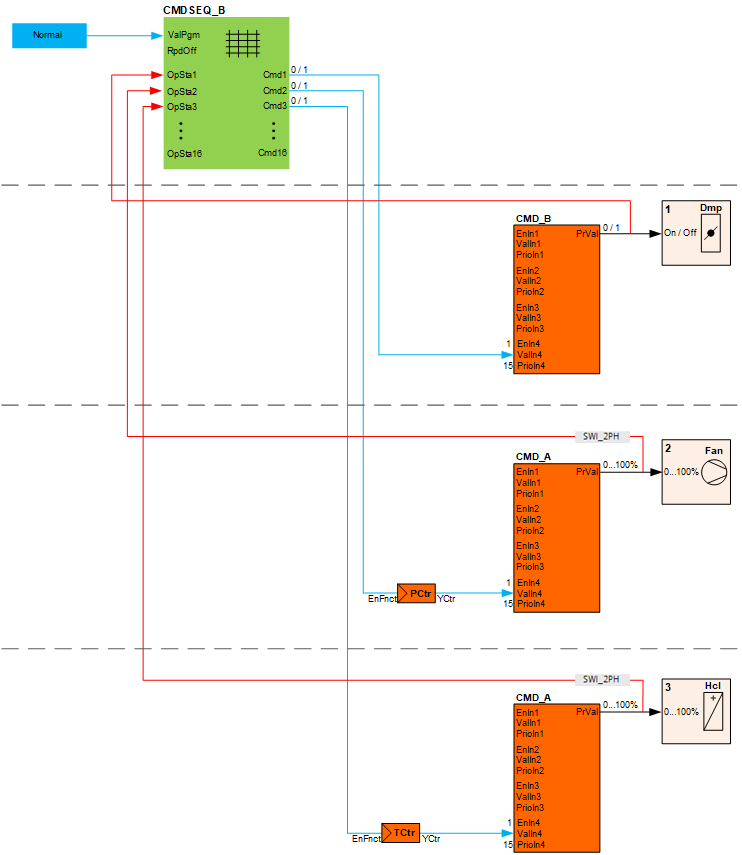
A binary signal is required for the return to an input [OpSta1]...[OpSta16] from CMDSEQ_B:
- CMD_B supplies the binary signal on output [PrVal].
- CMD_A requires a binary signal in addition to function block SWI_2PH to convert [PrVal]. The output provides value 1, if [PrVal] is greater than 4 [%].
- CMD_M requires a binary signal in addition to function block CMP_I to convert [PrVal]. Output [GT] provides value 1, if [PrVal] > 1 (0 is provided to [GT], where [PrVal] = 1).
Actual feedback signals from the plant components can be used, if available, instead of returning an output signal from an output block.
The next plant component is switched on or off by CMDSEQ_B only after the feedback from the prior plant component is received:
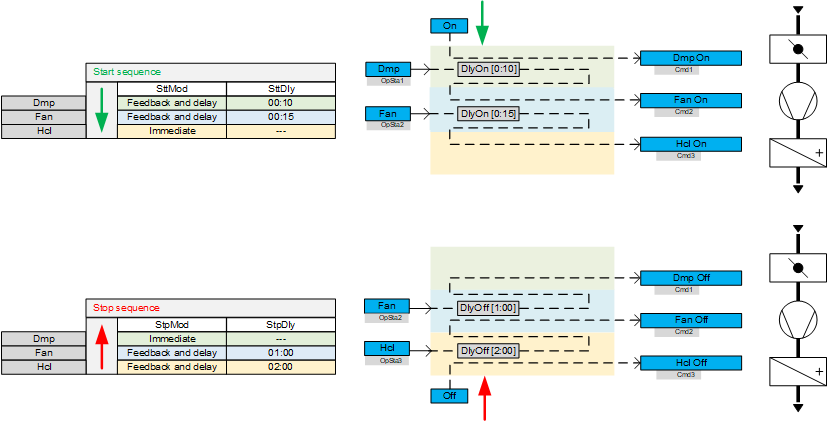
The start and stop delay type (SttMod and StpDly) and the start and stop delay time (SttMod and StpDly) are set in CMDSEQ_B.
 WARNING

Locking via function block CMDSEQ_B controls only the switch-on and switch-off workflow.
Feedbacks are no longer monitored during operation.
- Select the lock via the output blocks, if components are controlled that could be destroyed by overheating (e.g. electric heating coil).
This type of lock can be selected if the switch-on and switch-off sequence is to be controlled and continuous monitoring of the plant component is required during operation, for example, on a ventilation plant with an electric heating coil.
In this case, the heating coil must switch off immediately, if the fan is no longer switched on or the air damper is no longer opened.
WARNING
Overheating of the electric heating coil at insufficient volume flow.
Operating an electric heating coil without sufficient air flow may result in overheating and destroy the unit.
- Ensure that there is sufficient air flow to operate the electric heating coil.
- A flow detector must be installed in the air duct to monitor air flow.
- The flow detector must be locked with the electric heating coil so that the electric heating coil only operates when there is sufficient air flow.
- Moreover, the heating coil should be locked on the software side with the fan. The heating coil can only operate after an operating message for the fan output is available.
Output blocks CMD_A and CMD_B or their upstream controllers PCtr and TCtr receive a switch-on and switch-off command from CMDSEQ_B.
On the output block, the priority is defined for processing the signal, typically priority 15 (Automatic mode).
Output blocks are mutually locked with signals release [Rls] and forced [Frc].
Switch on and off delays are each set on a function block TMR_FNCT.
Function block SWI_2PH is also used on CMD_A to convert a binary signal in advance.
A red dot on the input [En] means that the signal is inverted.
Locking via output blocks controls the switch-on and switch-off workflow and also monitors operation. The output blocks locked with this output block are switched off if the release signal is no longer available during operation.
The same priority can only be used one time on input groups 1…4 (inputs [EnIn1], [ValIn1], [PrioIn1] to [EnIn4], [ValIn4], [PrioIn4]) of the output blocks. Function block ENSEL_R, ENSEL_BO or ENSEL_MS must be interconnected if multiple input signals are to act on the output block at the same priority. Value [Val] on active input [En1] to [En25] with the lowest number of the ENSEL is forwarded to the output block.
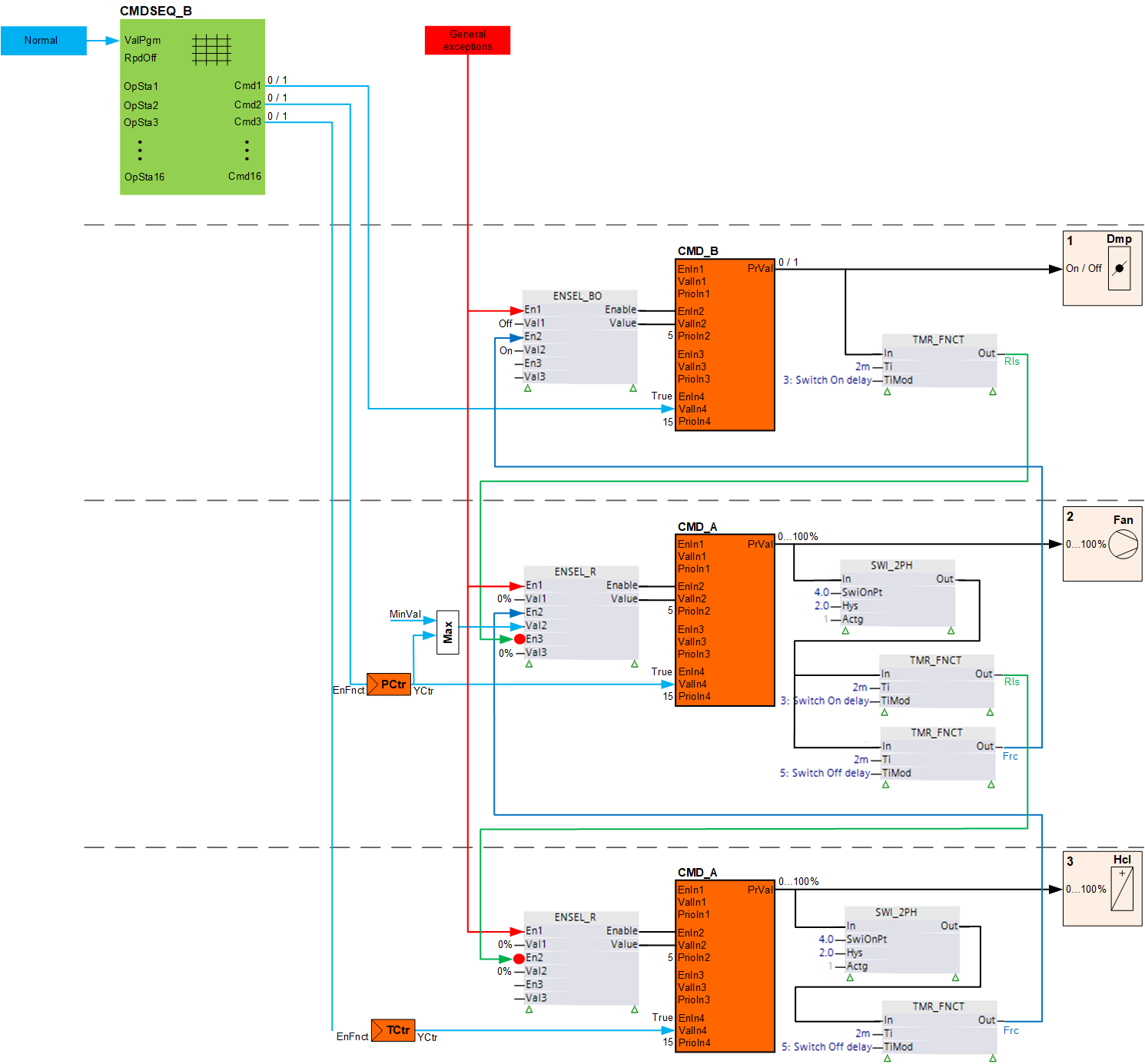
Switch-on workflow
After a switch-on command by CMDSEQ_B, only the air dampers can open immediately.
The fan is still locked, since the release signal [Rls] from the air damper is still missing (Value [PrVal] = 0 -> inverted = Value on input [En3] of ENSEL_R = 1 -> [Val3] = 0 [%]) and the heating coil is still missing the release signal from the fan. The missing release signal means that the output block at priority 5 is held at value 0 "Off".
After the set 'Switch On delay' expires, the air damper enables this release signal (value 1, inverted) and the lock at priority 5 is discontinued for the fan. Automatic mode at priority 15 takes effect and switches the fan at the desired setpoint 0-100 [%].
After the set 'Switch On delay' expires, the fan enables this release signal (value 1, inverted) and the lock at priority 5 is discontinued for the heating coil. Automatic mode at priority 15 takes effect and switches the heating coil at the desired setpoint 0-100 [%].
Switch-off workflow
The heating coil is switched off immediately after the switch-off command by function block CMDSEQ_B (Cmd1=0, Cmd2=0, Cmd3=0).
The fan still receives the force signal [Frc] from the heating coil and continues to operate at priority 5. As setpoint it continues to receive the controller setpoint but limited downward to the minimum setpoint.
The air damper receives the force signal from the fan and remains open at priority 5.
After the set 'Switch Off delay' expires for the heating coil, its force signal is discontinued, and the fan is switched off. At the same time, the fan's release signal is discontinued, and the heating coil is re-locked.
After the set 'Switch Off delay' expires for the fan, its force signal is discontinued, and the air damper closes. At the same time, the fan's release signal is discontinued, and the heating coil is re-locked.

In the displayed configuration, the lock with force signal [Frc] and release signal [Rls] is not active if a general exception mode exists. The general exception mode has a higher priority than [Frc] and [Rls] by pin assignment [En1] on ENSEL_R.