[SplyHw21] Supply chain hot water, data exchange with rooms (TRA integration), via grouping mechanism
Program block, name / node subtype: [SplyHw21] Supply chain hot water, data exchange with rooms (TRA integration), via grouping mechanism
Library hierarchy: Coordination
Family: SplyHw
Project tree | Diagram |
|---|---|
|
|
|
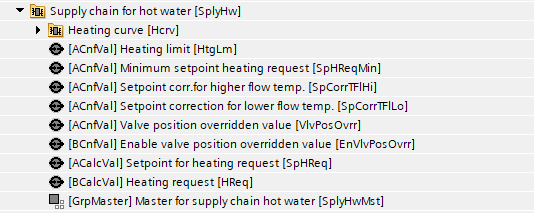
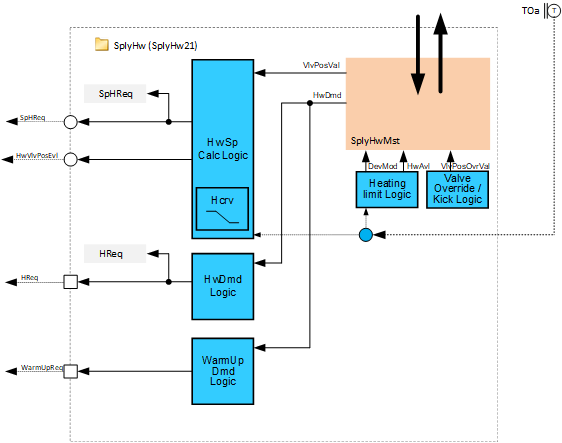
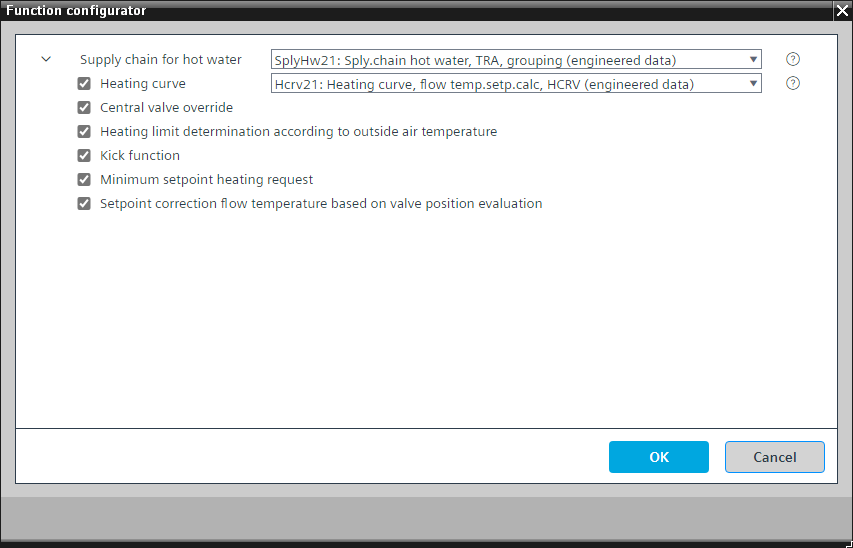
Configurator

Program blocks are stored in the library without I/Os. Use the auto-create and auto-connect functions to create I/Os and/or to connect them to the interface blocks, e.g., R_A, CMD_B. Alternatively, take the I/Os from the folder containing the predefined I/Os in the library and/or from the plant and connect them to the interface blocks.
SplyHw21 collects and analyzes hot water demand data from room automation area consumers through a group mechanism for use by the heating plant, and distributes the heating plant data back to the area consumers.
SplyHw21 can be connected to the heating plant either directly or via an intermediary coordinator (SplyHw23).
The most important functions in the program block are:
- Heating demand collection and evaluation
- Hot water temperature setpoint calculation and its correction based on valve position evaluation of the consumers
- Heating lockout (limit) based on outside air temperature
- Central valve override and valve kick
Name | Description | Type | Alarm / Notification class | Trend / Type | |
|---|---|---|---|---|---|
SpHReq | Setpoint for heating request | ACalcVal: Analog calculated value | N/A | N/A | |
HReq | Heating request | BCalcVal: Binary calculated value | N/A | N/A | |
SplyHwMst | Manager for supply chain hot water | GrpMaster: Group manager | N/A | N/A | |
Name | Description | Type | Alarm / Notification class | Trend / Type | |
|---|---|---|---|---|---|
SpHReqMin | Minimum setpoint heating request | ACnfVal: Analog configuration value | N/A | N/A | |
Hcrv | Heating curve | [Hcrv21] Heating curve, flow temperature setpoint calculation, with HCRV | N/A | N/A | |
Description |
|---|
|
Setpoint correction for flow temperature based on valve position evaluation Elements that belong to this option: Setpoint correction for lower flow temperature | ACnfVal: Analog configuration value Setpoint correction for higher flow temperature | ACnfVal: Analog configuration value |
Heating limit determination according to outside air temperature Element that belongs to this option: Heating limit | ACnfVal: Analog configuration value |
Central valve override Elements that belong to this option: Enable valve position overridden value | BCnfVal: Binary configuration value Valve position overridden value | ACnfVal: Analog configuration value |
Kick function |
Heating demand collection and evaluation
The hot water demand signal collected from area consumers is multi-state with the following enumeration:
- Off: Area is not using or requesting hot water.
- HeatDmd: Area is using or requesting hot water to meet heating demand.
- Warm up: Area is using or requesting hot water to meet warm-up demand.
SplyHw21 evaluates the data received and calculates the two binary output pin signals [HReq] and [WarmUpReq] for communication with the plant.
Hot water temperature setpoint calculation and its correction based on valve position evaluation of the consumers
SplyHw21 collects valve position values from room automation area consumers via group data exchange, and calculates a representative valve position percent value [HwVlvPosEvl]. [HwVlvPosEvl] is the average of valve positions that:
- Are ≥ 10 %
- Have no disturbances
- Are from area consumers with an active hot water demand signal
A linear function (configurable) uses [HwVlvPosEvl] to calculate a hot water supply temperature setpoint correction value between SpCorrTFlHi and SpCorrTFlLo:
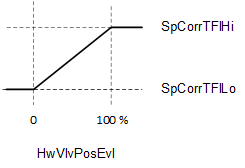
Key
SpCorrTFlHi | Setpoint correction for higher flow temperature |
SpCorrTFlLo | Setpoint correction for lower flow temperature |
HwVlvPosEvl | Supply chain hot water valve position evaluation |
The calculated setpoint correction value is added to the base setpoint (the base setpoint is calculated by applying a heating curve (see figure) based on outside air temperature [TOa]). The result is the hot water heating request setpoint value [SpHReq] (chart output pin).
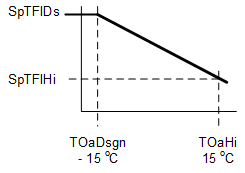
Key
SpTFlDs | Flow temperature setpoint for design outside temperature |
SpTFlHi | Flow temperature setpoint for high outside temperature |
TOaDsgn | Design outside temperature |
TOaHi | Outside temperature high |
The suggested setpoint value [SpHReq] can be delivered to the heating plant or other coordinator(s) (SplyHw23). The heating plant program, which may receive additional input from other coordinators, determines the actual setpoint value.
If a central valve override is active, SplyHw21 stops using area valve positions to calculate the setpoint. In this case, SplyHw21 delivers the previous setpoint value. When the override is no longer active, the normal process for setpoint calculation resumes.
Heating lockout (limit) based on outside air temperature
Hot water use in consumers is blocked if the outside air temperature is above a configured setting, HtgLm. By default, device modes of hot water consumers (radiant ceiling or heating coil) are set to 'Off' by a multistate Group Write with priority 9, if the outside air temperature goes above 16°C. However, in 2- or 4-pipe systems, the destination is the 'hot water available' BACnet object (xxHwAvl) commanded by a binary Group Write with priority 9. This disables heating and allows cooling to remain enabled.
Logic comparing [TOa] to the lockout parameters is local to the function in SplyHw21. A hysteresis (1K by default) prevents frequent switching of the lockout function, and a filter with a configurable time constant is also used. Both the filter and the hysteresis are editable in the chart.
With 2- or 4-pipe systems, the heating limit (HtgLm) for SplyHw21 must be equal or less than the cooling limit (CLm) for SplyChw21. Otherwise, there may be times between heating and cooling seasons when consumer device modes are set to 'Off' unintentionally.
Central valve override
Distribute a signal to manually command all room automation area hot water consumer valves with priority 8. BACnet objects are provided for enabling the command (EnVlvPosOvrr) and setting the valve position to be commanded (VlvPosOvrr).
Valve kick
To prevent actuators from getting stuck due to prolonged periods of inactivity, SplyHw21 commands the valves for hot water consumers briefly and periodically with priority 10.