[HExg21] Heat exchanger, temperature-controlled, with primary valve and secondary pump
Program block, name / node subtype: [HExg21] Heat exchanger, temperature-controlled, with primary valve and secondary pump
Library hierarchy: Heating equipment
Family: HGen
Project tree | Diagram |
|---|---|
|
|
|
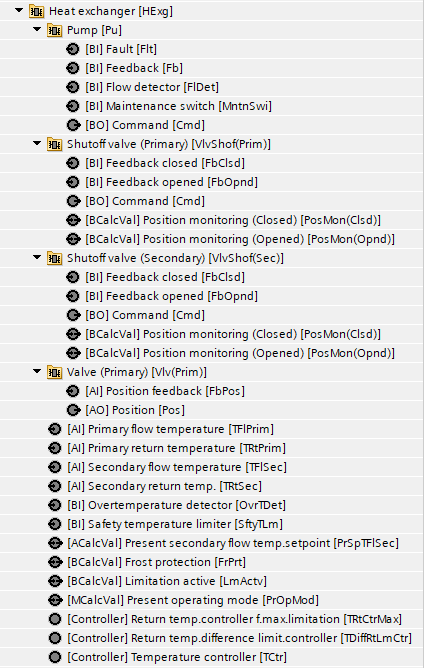
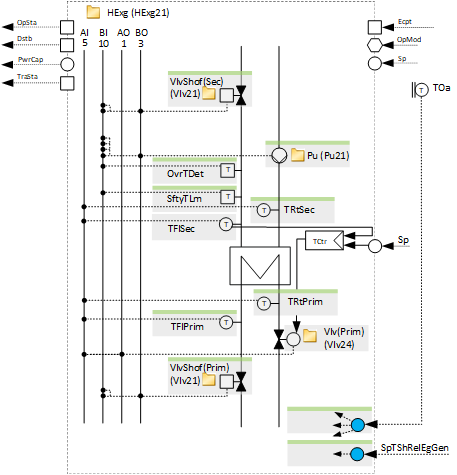
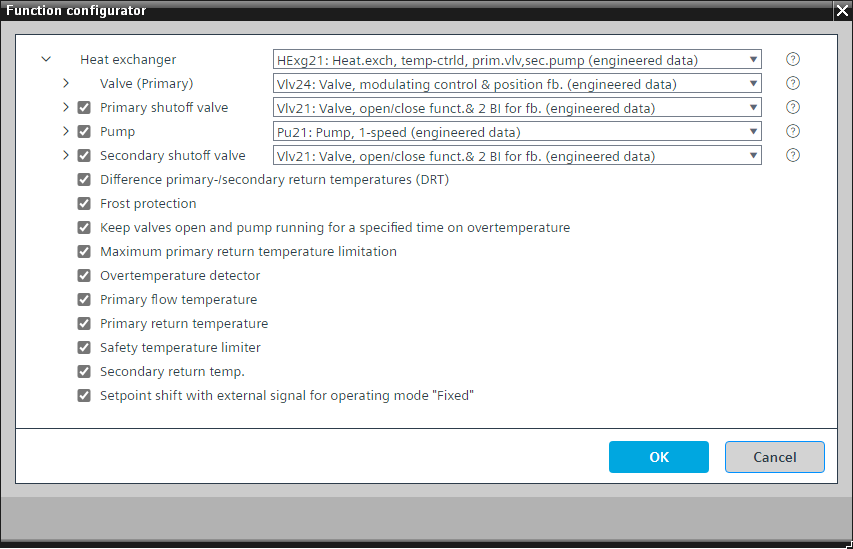
Configurator

Program blocks are stored in the library without I/Os. Use the auto-create and auto-connect functions to create I/Os and/or to connect them to the interface blocks, e.g., R_A, CMD_B. Alternatively, take the I/Os from the folder containing the predefined I/Os in the library and/or from the plant and connect them to the interface blocks.
Controls a heat exchanger.
A PID controller compares the present secondary flow temperature setpoint (PrSpTFlSec) with the secondary flow temperature and changes the position of a primary valve (Vlv24).
The program has settings for the nominal power of the heat exchanger and for the transient state times (a signal that the heat exchanger is in a transient state that blocks the logic for generating further step-up and step-down pulses for the power control and compensation) when switching on or off (e.g., 5 minutes when switching on and 2 minutes when switching off).
The switch-on and switch-off sequence for the valves and the pump are defined in the function block CMDSEQ_B.
This program block has the following optional functions:
Option: Primary shutoff valve (1xBO, 2xBI)
Controls a shutoff valve that opens when the heat exchanger is running (Vlv21).
Option: Pump (1xBO, 4xBI)
Controls a pump (Pu21). Different alternatives are possible, e.g., TwnPu21.
The pump runs when the heat exchanger is running, and the optional shutoff valve is open.
Option: Secondary shutoff valve (1xBO, 2xBI)
Controls a shutoff valve that opens when the heat exchanger is running (Vlv21).
Option: Difference primary and secondary return temperatures (DRT)
A PID controller compares the difference between the primary and secondary flow temperatures to a given setpoint, e.g., 10 K, and limits the maximum controller output of the flow temperature controller to prevent too large a difference between the two temperatures (especially during start-up).
This option can only be applied successfully together with the optional primary return temperature and the secondary return temperature.
Option: Frost protection
If any temperature around the heat exchanger falls below a certain value, e.g., 8 °C, the secondary shutoff valve opens and the pump starts to ensure water circulation.
If the temperatures fall further, e.g., to 5 °C, the operating mode switches to "On".
Option: Keep valves open and pump running for specified time on overtemperature
In case of overtemperature, the shutoff valve is kept open and the pump continues to run for a specified time, e.g., 2 minutes.
Option: Maximum primary return temperature limitation
A PID controller compares the primary return temperatures to a setpoint dependent on the outdoor temperature, e.g., 70 °C at -20 °C and 50 °C at 20 °C, and limits the maximum controller output of the flow temperature controller.
You can set the maximum limit setpoint in a CHAR_LIN.
Option: Overtemperature detector (1xBI)
Reads the signal from an overtemperature detector and generates an alarm.
The program logic stops the heat exchanger. When the option "Keep valves open and pump running for specified time on overtemperature" is active, the pump stops and the shutoff valve closes with a delay. Otherwise, the pump stops and the shutoff valve closes immediately.
Option: Primary flow temperature (1xAI)
Creates an analog input for the primary flow temperature and reads its signal. It can generate an alarm (high and low limit).
Option: Primary return temperature (1xAI)
Creates an analog input for the primary return temperature and reads its signal. It can generate an alarm (high and low limit).
Option: Safety temperature limiter (1xBI)
Reads the signal from a safety temperature limiter and generates an alarm.
The program logic stops the heat exchanger. When the option "Keep valves open and pump running for specified time on overtemperature" is active, the pump stops and the shutoff valve closes with a delay. Otherwise, the pump stops and the shutoff valve closes immediately.
Option: Secondary return temperature (1xAI)
Creates an analog input for the primary return temperature and reads its signal. It can generate an alarm (high and low limit).
Option: Setpoint shift with external signal for operating mode "Fixed"
The heat exchanger has an operating mode "Fixed". The operating mode "Fixed" comes after the mode "On". It ensures that this heat exchanger stays at its nominal power and that another energy generator that has been switched on after it is modulating maintains the main flow temperature.
A PID controller in another program block (HGenCtl22) compares the main flow temperature to its setpoint and, in case of a deviation, increases its output (in %). The heat exchanger can read this signal and if its operating mode is "Fixed", it results in a local setpoint increase, e.g., 0-100 % increases the setpoint of the heat exchanger by 0-3 K). This keeps the heat exchanger at its nominal power and prevents its modulation.
Name | Description | Type | Alarm / Notification class | Trend / Type | |
|---|---|---|---|---|---|
Vlv (Prim) | Valve | N/A | N/A | ||
TCtr | Temperature controller | Ctr: Controller | No | No | |
TFlSec | Secondary flow temperature | AI: Analog input | Yes, 4 | Yes, 2 | |
PrSpTFlSec | Present secondary flow temperature setpoint | ACalcVal: Analog calculated value | No | No | |
Name | Description | Type | Alarm / Notification class | Trend / Type | |
|---|---|---|---|---|---|
|
SftyTLm | Safety temperature limiter | BI: Binary input | Yes, 5 | No | |
OvrTDet | Overtemperature detector | BI: Binary input | Yes, 4 | No | |
VlvShof (Prim) | Shutoff valve | N/A | N/A | ||
Pu | Pump | N/A | N/A | ||
VlvShof (Sec) | Shutoff valve | N/A | N/A | ||
TRtPrim | Primary return temperature | AI: Analog input | No | Yes, 2 | |
TRtSec | Secondary return temperature | AI: Analog input | No | Yes, 2 | |
TFlSec | Secondary flow temperature | AI: Analog input | Yes, 4 | Yes, 2 | |
TFlPrim | Primary flow temperature | AI: Analog input | No | Yes, 2 | |
FrPrt | Frost protection | BI: Binary input | Yes, 5 | No | |
Description |
|---|
Setpoint shift with external signal for operating mode "Fixed" |
Keep valves open and pump running for a specified time on overtemperature |
Primary return temperature maximum limitation |
Difference of primary/secondary return temperatures limitation (DRT) |